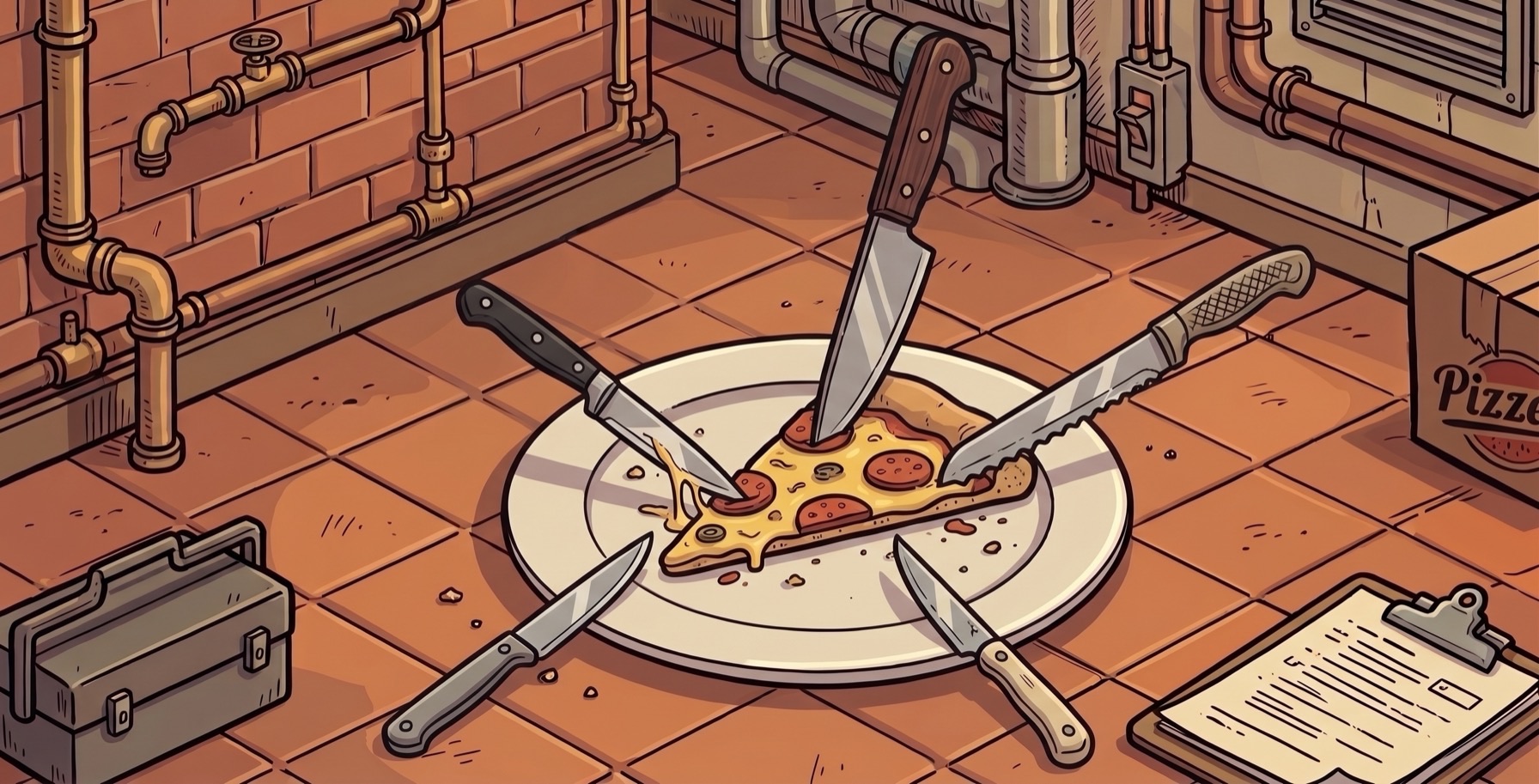
We are Fighting Over a Single Slice of Pizza - It's Time to Grow the Pie
The EAC market for cement and concrete has just a few serious buyers, leaving the industry tangled in a fight over how to split that one slice instead of growing the pie: a wider buyers market. While the fight drags on, nobody eats enough.
Executive Summary
Since 2022 the emerging EAC market for cement has been split on its objective: certificates reserved for deep decarbonization or open to Novel SCMs as well.
Both camps name a real risk but the fight misses the forest for the trees: the market is super nascent and both solutions need to scale quickly. EACs are an unlock.
SCMs took 30 years to reach roughly 15% of US binder; full decarbonization by 2050 requires three to four times that in every region; that growth rate needs capital support
Deep decarbonization pathways — ACMs, CCU, and CCS — have long development cycles and higher cost; every year of delay is a year the industry cannot get back.
Retrofitting 3,000+ cement plants in 288 months is a BOTH AND problem, not an either or. The EAC market has to be built for BOTH AND.
An environmental attribute certificate (“EAC”) is a receipt for carbon that was never emitted. A producer pours a lower-carbon tonne, the reduction is verified against a regional baseline, and the certificate carries that attribute to a buyer who did not pour it.
Since suppliers & buyers started talking about EACs for cement in 2022, the industry has been torn into two camps: those who believe EACs should be reserved for deep decarbonization with steeper cost curves, and those who believe novel SCMs (i.e. not virgin fly ash or GGBS) that are lower cost and faster to scale should have access to the market too.
Both sides have rational, legitimate concerns.
Deep Decarbonization Camp
We must start pushing 80%+ decarb solutions now. If cheaper EACs come onto the market, these technologies will be priced out and lose further ground. Why would anyone buy a $200 EAC when a $50 EAC is available?
Novel SCM Camp
Novel SCMs across much of the world have not reached their potential. Introducing and scaling these SCMs carries real costs and requires contracted revenue. Why shouldn't we scale the lowest-cost solutions as fast as we can?
And yet, as emissions are cumulative and each tonne of cement & concrete is only manufactured and poured once - the sooner we decarbonize the better. How can the market zoom out and retool for scaling everything we need?
We need the full stack of solutions
For the last six months, CTC has been publishing a series of white papers on the scale of the cement & concrete decarbonization challenge and how to really unlock markets to address it. The scale of the problem is worth restating.
4 Gt
Cement produced annually
3,000+
Cement plants to decarbonize
288
Months remaining to 2050
As of this writing. That's 2.6 plants per day.
The good news is that we have plenty of technologies. What we do not have is a single zero-carbon solution that meets the hurdle for capital markets to invest: those that will scale in time, hit cost parity, and work as well as, or better than, the current supply chain (See our Price, Scale, Functionality, Carbon series here). Every solution class is strong on some dimensions and challenged on others.
No single winner
Solution classes scored across the SPFC lens — 1 (weak) to 3 (strong)
No single winner. SCMs are cheap and scalable but capped on carbon. The carbon leaders are CCU and CCS, and both pay for it on price — CCS scores the bottom of the cost scale - the most expensive solution by far - but it superior on functionality, precisely because it leaves the product unchanged.
The good news: if we mix and stack these solutions and optimize for carbon, it is possible to reach the goal.
So how do they stack at the MARKET level.
The industry does mostly agree on the solution set - where they differ is the relative mix.
Two roadmaps, the same levers, split differently
Share of the abatement task carried by each lever — the step sizes are the fight
GCCA's 2050 Decarbonization Roadmap: SCMs = savings in cement and binders (9%) plus efficiency in concrete production (11%). ACMs = alternatives to Portland clinker (0.5%). CCUS is not split into CCU and CCS in the roadmap. Other levers = savings in clinker production (11%), efficiency in design and construction (22%), recarbonation (6%), decarbonisation of electricity (5%).
Each waterfall steps the abatement task down to zero. Values are percentage points of reduction against the regional baseline.
Without trying to settle the mix argument or the how-far-we-go argument, one thing is clear: the market will need both SCMs and deep decarbonization solutions. The real questions are whether SCMs require EACs, and when the deep decarbonization build-out has to start.
Do Novel SCMs need EACs?
For decades the industry has successfully blended in SCMs from the coal and steel industries without EACs. But mainstream adoption in the US took close to 30 years, from the late 1990s to today, and it has reached only about 15% of the binder.
That is roughly half a percentage point a year. Reaching 50% SCM content in 23 years means adding 35 points, or about 1.5 points a year — three times the pace of the last three decades. And that assumes the existing supply holds, which it will not. Coal plants are closing and taking their fly ash with them. Replacing what is lost while still reaching 50% pushes the requirement closer to two points a year, or four times the historic pace. And that is the US alone.
So if they are cheaper and functional, why aren't they scaling faster? Novel SCMs face the same chicken and egg issue or valley of death like other technologies. In order for the new SCMs to come down in price and be available, they must scale production. In order to finance scaled production, the risk that the market will buy the new product must come down. This is a major issue for new companies manufacturing novel SCMs, who lack a track record or balance sheet to access low-cost capital to build first of a kind manufacturing facilities; especially given the known issue that concrete is a spot market without long-dated off-take agreements. All together, that means financing these is extremely difficult, slowing the pace of change.
EACs introduce firm offtake for novel SCM producers: they defray revenue risk and early growth costs, let a new technology prove performance and reach economies of scale, and put it on a trajectory that needs no further subsidy.
Scaling SCMs fast enough to hit the 2050 goal requires EAC support, likely at lower unit prices than complementary, but higher cost, deep decarb levers.
When do deep decarb solutions have to start scaling?
If we allow low-cost SCM EACs at the expense of Deep Decarbonization EACs, can we afford to delay the deep decarbonization pathways today — ACMs, CCU, CCS — and wait to see how far the SCM plants take us?
No.
No projection in the market today sees a world without OPC. There are 3,000+ plants, trillions of invested capital, and 288 months. Yet every deep decarbonization pathway for OPC or equivalents runs on a longer development cycle: first-of-a-kind plants take years to permit and build, first-projects are sub-scale and non-economical requiring subsidy to finance, and ACMs need years of production history before the market will trust them in structural applications.
So, capture, utilization and/or storage (CCUS) of OPC emissions + ACMs will be needed. All need to mature. If the industry delays them by a decade, it misses the window to learn how carbon can be utilized versus stored and how can existing plants retrofit to ACM technology.
Decarbonizing 3,000 plants by 2050 will require ACMs, CCU, and almost certainly CCS. If the industry doesn’t use the EACs now to start perfecting these pathways now, it will miss the 2050 target.
“And,” not “Or”
The industry needs both SCMs and deep decarbonization solutions to scale. Both solutions need EACs, so this argument is a false choice.
If the industry continues down the path of pretending we can choose whether or not SCMs need to be part of the EAC market, the industry will fail to meet its targets by 2050. We live in a time of ANDs, not ORs.
If splitting the piece of pizza isn't the answer, what is?
It's growing the pie.
That is the topic of Part II of this paper: Build the Kitchen So Everyone Can Eat. We will explore how EAC markets can evolve to widen the pool of buyers, diversify its offerings & price points, stack credits and scale the full suite of solutions we need.
Go Deeper
This paper draws on CTC's published research. Each topic above is explored in depth:
Paper Two lays out the market that funds both camps: one market, many price points, with basket integrity holding the premium in place.