Why Non-Dilutive Financing Is the Missing Ingredient
Cement and Concrete Decarbonization Demands a New Capital Stack
Executive Summary
Cement and concrete are responsible for roughly 8% of global CO₂ emissions — the technologies to decarbonize increasingly exist, but the financing structures to deploy them at scale do not.
Climate private markets hold ~$90 billion in dry powder, but 75% is concentrated in 58 mega-funds targeting mature, lower-risk technologies — leaving a structural 'missing middle' for FOAK industrial projects.
Equity alone cannot scale industrial decarbonization: it creates excessive dilution, misaligned cost of capital, and scaling bottlenecks for capital-intensive cement and concrete technologies.
Non-dilutive mechanisms — including loan guarantees, offtake agreements, tax credits, catalytic debt, and procurement-backed structures — are the essential bridge from innovation to bankable infrastructure.
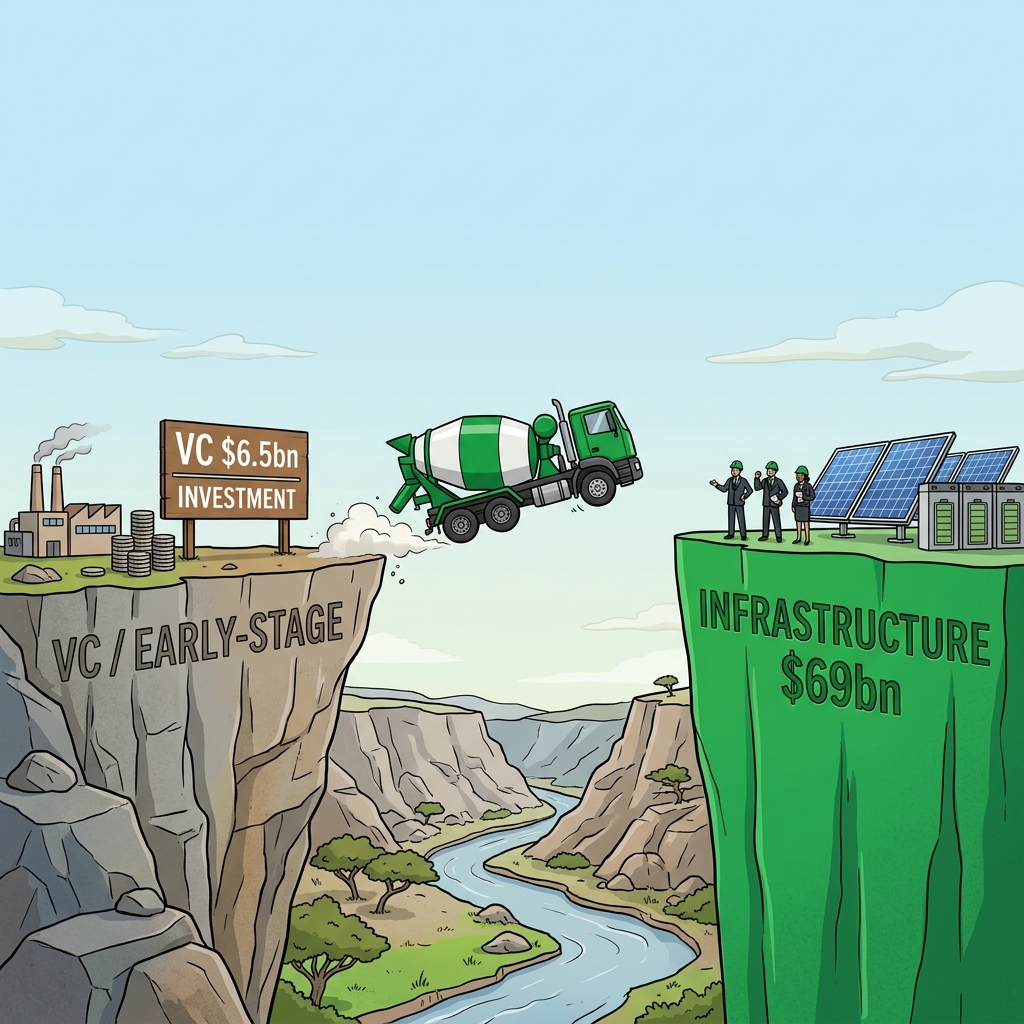
The “Missing Middle” — infrastructure capital floods mature technologies while FOAK industrial projects are stranded across the valley.
Cement and concrete sit at the center of the global climate challenge. Together, they are responsible for roughly 8% of global CO₂ emissions, making them one of the world's largest hard-to-abate sectors. Yet they are also foundational to economic development, housing, transportation, and energy infrastructure.
The technologies needed to decarbonize cement and concrete increasingly exist. Novel cements, supplementary cementitious materials (SCMs), carbon mineralization, electrified kilns, and carbon capture systems are all advancing from pilot to commercial scale. The problem is no longer purely technological. It is financial.
More specifically, the sector faces an acute shortage of non-dilutive capital capable of supporting first-of-a-kind (FOAK) industrial deployment. Yet, climate private markets are awash in dry powder; it's just not necessarily in the parts of the capital stack that industrial decarbonization companies need most.
The Paradox: Record Climate Capital, Persistent Industrial Funding Gaps
According to recent analysis from Sightline Climate, climate-focused investors held approximately $90 billion in dry powder as of Q1 2026. However, the composition of that capital matters far more than the headline number.
The majority of available capital is increasingly concentrated in large infrastructure funds focused on mature, lower-risk technologies. Sightline Climate notes that 75% of all climate capital is concentrated in just 58 mega-funds, with institutional investors favoring scalable deployment plays that offer stable, infrastructure-like yields. Venture capital fundraising, by contrast, has weakened significantly, with climate VC fund close rates dropping to just 39%.
Investable Dry Powder for Climate Stands at $90bn
Total capital available for deployment by quarter ($bn)
This dynamic creates a structural mismatch for industrial decarbonization startups:
- Too capital intensive for traditional venture capital once they move beyond pilot scale.
- Too technologically novel and operationally risky for conventional project finance lenders.
This challenge is often referred to as the 'missing middle' — the financing gap between venture-backed innovation and bankable infrastructure deployment.
Why the Gap Is Especially Acute in Cement and Concrete
The missing middle is especially pronounced in cement and concrete because deployment requires:
- Expensive retrofits to long-lived industrial assets
- Integration into existing manufacturing systems and established value chains
- Multi-year construction timelines
- Commodity margin economics
- Regulatory and procurement certainty
These are not software-style scaling dynamics. They are industrial infrastructure dynamics.
Why Equity Alone Cannot Scale Industrial Decarbonization
Historically, climate technology fundraising narratives have focused heavily on venture equity. That model worked well for asset-light businesses such as SaaS, marketplaces, or certain renewable energy technologies with rapidly declining cost curves.
But cement and concrete decarbonization do not fit that mold. FOAK facilities in low-carbon cement, carbon mineralization, or carbon capture can require tens or hundreds of millions of dollars before meaningful revenues materialize. Projects in the 'FOAK scale' often range from $50 million up to $500 million — too large for venture investors and too risky for traditional lenders.
- Excessive Dilution: Repeated equity raises to finance manufacturing plants can severely dilute ownership before commercial scale is achieved.
- Misaligned Cost of Capital: Equity is the most expensive form of capital. Using it to fund infrastructure-heavy deployment raises hurdle rates and slows adoption.
- Capital Inefficiency: Venture equity is poorly suited to financing steel, concrete, kilns, pipelines, and industrial equipment with longer payback periods.
- Scaling Bottlenecks: Even well-capitalized startups can stall when project finance markets are unwilling to underwrite deployment risk.
The implication is clear: industrial decarbonization cannot scale on venture equity alone.
"There is not a generalized shortage of climate capital. There is a shortage of appropriately structured climate capital."
Non-Dilutive Financing Is the Bridge to Commercialization
To cross the commercialization gap, the cement and concrete sector needs far more non-dilutive financing mechanisms.
These include (to name a few):
- Government grants
- Loan guarantees
- Revenue guarantees
- Catalytic capital (concessional and flexible debt)
- Credit enhancements
- Structured project finance
- Advance market commitments
- Carbon contracts or environmental attribute certificates
- Tax credits (e.g., 45Q or 48C)
- Procurement-backed financing structures
These tools reduce the cost of capital while preserving equity ownership and improving project bankability. The World Economic Forum argues that blended finance structures are essential for FOAK cement and concrete projects because they can absorb early deployment risk and crowd in commercial lenders.
Lenders still struggle with two core underwriting challenges in industrial decarbonization:
- Limited operational data for emerging technologies
- Lack of long-term contracted demand for low-carbon materials
Without solutions to those challenges, debt providers either avoid the market entirely or demand equity-like returns for debt financing.
How Non-Dilutive Mechanisms Solve These Challenges
- Loan guarantees reduce lender downside exposure
- Offtake agreements create predictable revenue streams
- Public procurement programs create demand certainty
- Tax credits improve project economics
- Concessional or flexible debt lower weighted average cost of capital
Together, these structures can make projects financeable without forcing companies into endless equity raises.
Cement and Concrete Are Becoming a Test Case for Industrial Finance Innovation
The good news is that parts of the market are beginning to respond.
Concrete Transition Capital was founded precisely for the reasons highlighted — to address the missing middle financing gap. The firm combines a team with deep sector expertise, its proprietary database and models that support rigorous underwriting, and private debt and investing experience to deploy and accelerate capital to FOAK projects backing superior technologies.
Furthermore, organizations such as RMI are working to unlock demand-side financing mechanisms, including procurement frameworks and 'book-and-claim' systems designed to accelerate adoption of low-carbon concrete.
Meanwhile, initiatives such as the Clean Concrete Pledge are aggregating buyers across cities, developers, and suppliers to create more credible demand signals for low-carbon materials. These developments matter because demand certainty is often the prerequisite for attracting debt capital.
Where Dry Powder Is — and Where It Is Not
The current climate capital landscape reveals an important truth: there is not a generalized shortage of climate capital. There is a shortage of appropriately structured climate capital.
According to Sightline, infrastructure investors continue to raise and deploy large pools of capital into mature technologies with proven risk-adjusted returns.
The “Missing Middle” — infrastructure capital floods mature technologies while FOAK industrial projects go unfunded.
Figure 1: The Capital Stack Divergence
New climate fundraising (AUM in $bn) by vehicle type over time.
Infrastructure
Growing dominance in proven deployment
Source: Sightline Climate, April 2026
Venture Capital / Growth
Collapsing close rates and capital flight
Source: Sightline Climate, April 2026
75% of all climate capital is now concentrated in just 58 mega-funds targeting proven infrastructure plays — while the “missing middle” of industrial decarbonization goes unfunded.
But the market remains undercapitalized where industrial decarbonization companies need support most:
This leaves many promising cement and concrete technologies stranded between innovation and infrastructure.
Private markets are effectively signaling: "Come back when the technology is proven and revenues are contracted."
But technologies cannot become proven at scale without financing the first commercial deployments. That is the core market failure.
The Next Era of Climate Finance Will Be Industrial
The next decade of climate investing will look fundamentally different from the last. The early climate era rewarded software-enabled efficiency, renewable energy generation, and asset-light business models. The next phase requires rebuilding industrial systems: cement, steel, chemicals, fuels, shipping, and heavy manufacturing.
That transition demands new financing structures. Industrial decarbonization will not scale through venture capital alone. It requires layered capital stacks capable of supporting expensive, risky, and strategically important infrastructure transitions.
For cement and concrete specifically, the path forward depends on:
The technologies are increasingly real. The emissions imperative is undeniable. The dry powder exists. What remains missing is the financial bridge between innovation and industrial scale.
References
Go Deeper
Explore the related Concrete Ideas that expand on the financing, capital structure, and market-building themes in this paper.
Non-dilutive financing is the missing link. Explore how CTC is building the financial bridge for FOAK cement and concrete projects.