The Technology Pathways to Decarbonize Cement and Concrete
Executive Summary
Cement and concrete decarbonize through two main levers: (A) decarbonize clinker/cement production and (B) use less clinker to deliver the same performance.
Using less clinker is the fastest lever because it works with today's plants and distribution — if SCM supply, standards, and QC keep up.
Decarbonizing clinker production delivers deep abatement but is capital-intensive and infrastructure-dependent (fuels, power, CO₂ transport & storage).
The transition won't be one technology — it will be stacked pathways, sequenced by region based on feedstocks, grid, policy, logistics, and risk tolerance.
Finance is the gating function: most solutions are technically real; scaling depends on bankability, repeatable underwriting, and demand pull.
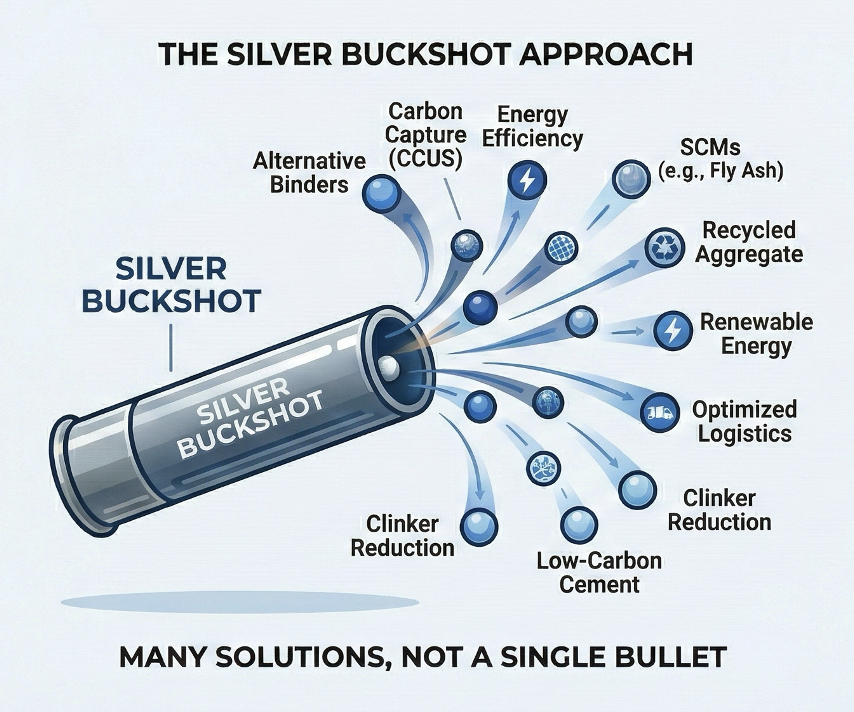
There is no silver bullet for cement and concrete. There is silver buckshot — a portfolio of overlapping technology pathways, each with different maturity curves, cost profiles, and deployment constraints. The sector is too large, too distributed, and too deeply embedded in global infrastructure for any single solution to carry the burden alone.
The good news: the pathways are well-understood. They sort cleanly into two levers. Understanding what each lever can do, where it works, and what holds it back is the foundation of any serious strategy to finance, build, or scale low-carbon concrete.
The Two Main Levers
Decarbonize the Production of Clinker/Cement
Deep abatement — project-finance hard
This lever reduces emissions per ton of clinker/cement by addressing three sources: process CO₂ from limestone calcination, thermal energy to run the kiln, and electricity for grinding, conveying, and capture systems.
A1) Carbon Capture, Utilization, and Storage (CCS/CCUS)
"Keep clinker, remove CO₂"
Capture CO₂ from kiln exhaust (post-combustion) or redesign the process (oxy-fuel, calcium looping, etc.), then store or utilize it. This is the only pathway that can drive ~90%+ abatement while maintaining conventional clinker production — critical for plants with decades of remaining life. What holds it back: FOAK risk, massive CAPEX, energy penalty, and the "missing middle" infrastructure (transport + permitted storage).
A2) Low-Carbon Thermal Energy
"Decarbonize kiln heat"
Reduce fossil combustion emissions using alternative fuels (biogenic, waste-derived) and, in some cases over time, electrification or hydrogen (where feasible). This cuts the combustion slice of emissions and can be layered with other measures. What holds it back: fuel availability, permitting, air emissions constraints, and variable economics by region.
A3) Efficiency + Operational Excellence at the Plant
"Make the same clinker with less energy"
Heat recovery, better process controls, improved grinding efficiency, upgraded preheaters/precalciners, and maintenance regimes that reduce energy intensity. Often the lowest-cost abatement per ton and improves margins. What holds it back: incremental gains, fragmented upgrade cycles, and limited ability to reach near-zero alone.
A4) New Clinker/Cement Chemistries
"Change the emissions equation at the source"
Alternative production routes that reduce or bypass limestone decarbonation, or lock carbon into products, depending on the chemistry. Potential for step-change emissions reductions without requiring full CCS in every context. What holds it back: qualification timelines, durability datasets, plant retooling CAPEX, and bankability.
Lever A headline: Deep abatement is available, but it's project-finance hard — high CAPEX, infrastructure dependency, and long lead times.
Use Less Clinker-Based Cement
The near-term workhorse
This lever reduces emissions by shrinking the clinker share required for a given performance outcome — either by (i) lowering clinker in cement, (ii) lowering cement in concrete, or (iii) using less concrete through design efficiency.
B1) Lower Clinker Factor via SCM Substitution
"Replace clinker in the bag"
Substitute clinker with SCMs such as fly ash, slag, calcined clays (e.g., LC3), natural pozzolans, ground glass pozzolan, and optimized limestone fillers. This is the fastest route to scale because it leverages existing plants, terminals, and standards pathways (in many markets). Often 20–40% abatement with relatively low CAPEX. What holds it back: SCM scarcity/decline (especially fly ash), regional supply imbalance, variability/QC, and slow-moving standards & specs.
B2) Less Cement per Cubic Meter
"Reduce paste demand"
Particle packing optimization, better admixture systems, strength-based specification, improved curing, and QC that enables lower cement content without sacrificing workability or durability. Can reduce cement content 10–30% in many applications, often at low cost, and compounds with SCMs. What holds it back: risk aversion and overdesign, inconsistent QC across jobsites, and misaligned incentives (no one gets paid to save cement).
B3) Structural/Material Efficiency
"Use less concrete for the same function"
Smarter structural design, higher-strength mixes used strategically, modularization, and digital engineering workflows that reduce volume and over-specification. Avoids emissions entirely and scales through engineering norms. What holds it back: fragmented responsibility across designers/specifiers/GCs, conservative norms, and limited feedback loops.
B4) New Binders as Clinker Displacement
"Replace Portland cement, not just clinker"
Alternative binders deployed in specific applications where qualification and durability are proven. Potentially 50–90%+ reductions in targeted segments and can unlock new supply chains. What holds it back: codes/standards, long durability proof cycles, and bankability for new plants.
Lever B headline: This is the near-term workhorse — but it's a supply chain + standards + QC problem as much as a technology problem.
The Full Roadmap: Getting to Net Zero
The Global Cement and Concrete Association (GCCA) has done some of the most important and rigorous work in mapping the full decarbonization roadmap for this sector. Their net-zero pathway makes one thing clear: no single lever gets the industry to net zero. It takes all of them — efficiency in design and construction (22%), efficiency in concrete production (11%), savings in cement & binders (9%), savings in clinker production (11%), CCUS (36%), decarbonization of electricity (5%), and recarbonation (6%) — stacked together over three decades.
This chart is the clearest illustration of why this is a portfolio transition, not a technology horse-race. The sector needs many solutions deployed simultaneously, scaled regionally, and financed repeatably.
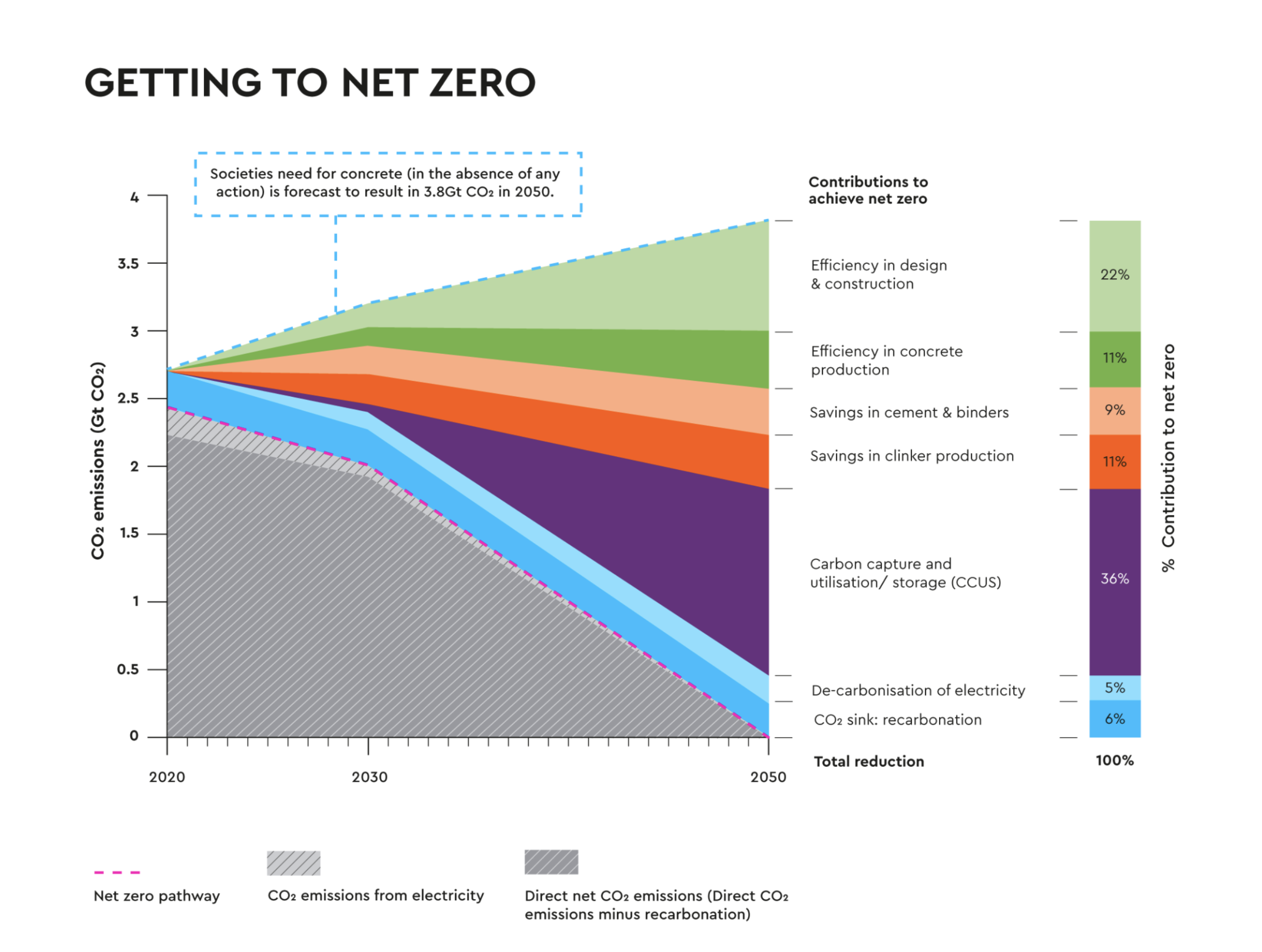
Source: Global Cement and Concrete Association (GCCA), "Getting to Net Zero" roadmap. The GCCA's work — convening producers, mapping pathways, and setting science-based targets — has been foundational for the entire sector's climate strategy.
How the Portfolio Stacks (and Why Regions Differ)
Decarbonization doesn't "pick a winner." It stacks pathways based on local constraints:
SCM-rich regions: Aggressive clinker reduction + mix optimization first; CCS later where infrastructure exists.
Coal-phaseout regions (fly ash decline): LC3/calcined clay + natural pozzolans + new SCM supply chains become strategic.
Strong carbon policy + storage geology: CCS becomes financeable earlier.
High growth, limited legacy assets: Opportunity to leapfrog with lower-clinker systems and new production pathways — if supply chains can be built locally.
Understanding the technology landscape is the first step. The next question is: why do these pathways struggle to cross from pilot to commercial scale?