The Concrete Valley of Death
FOAK projects are too risky for debt and don't generate enough return for all-equity. That financing gap is where the transition stalls.
Executive Summary
FOAK low-carbon cement plants sit in a financing no-man's-land: too risky for project finance debt, too capital-intensive with too little return for all-equity.
Lenders require proven cash flows, bankable offtake, and operating history — none of which a first plant can provide.
Equity investors face diluted returns because the capital intensity of industrial plants means IRRs cannot compensate for first-mover risk without leverage.
The result is a capital stack that doesn't close: no debt means no project, and no project means no precedent for future debt.
Breaking this cycle requires blended structures — catalytic capital, credit enhancement, and contracted revenue — that de-risk the first projects enough to unlock conventional finance for the next ones.
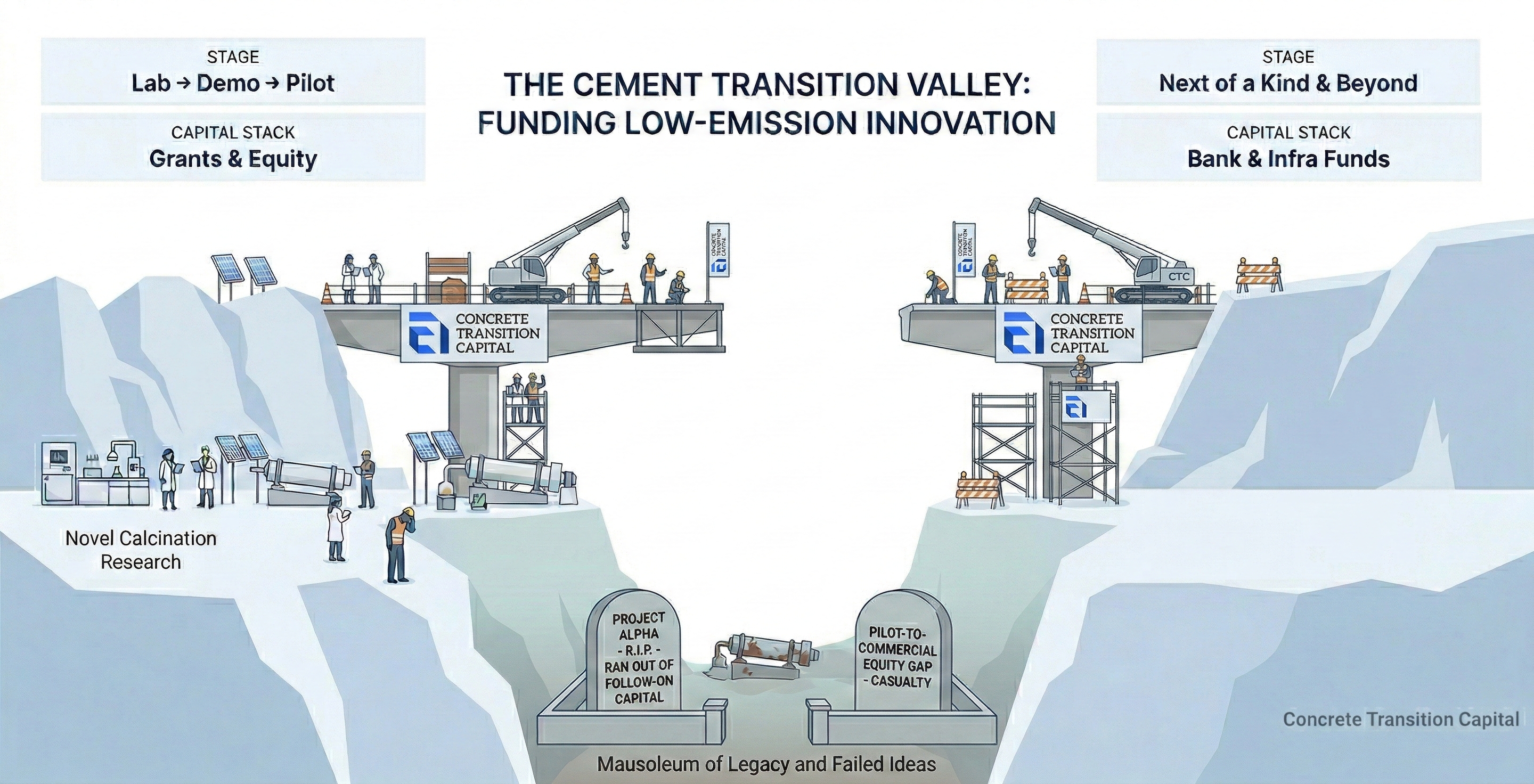
Low-carbon cement technologies work. Dozens of pilots have proven that alternative binders, carbon-mineralized aggregates, novel SCMs, and CCUS-enabled production can meet or exceed performance requirements. The technology risk is largely resolved.
But between a successful pilot and the first commercial-scale plant lies a financing gap that has stalled more climate technologies than any technical failure. This is the Valley of Death — and in concrete, the problem is fundamentally financial: FOAK projects are too risky for conventional debt, and they don't generate enough return to justify all-equity financing.
Too Risky for Debt
Project finance lenders underwrite cash flows, not technology. They require contracted revenue, proven operating history, and a demonstrable ability to service debt through economic cycles. A FOAK low-carbon cement plant fails every one of these tests.
There is no operating history at commercial scale. Revenue projections depend on offtake agreements that may not yet exist, or that carry green premiums the market has never tested. Construction risk is real — equipment integration, ramp-up timelines, and quality control at scale are all unproven. Lenders see a project where the downside is total loss and the upside is repayment at par. That is not an attractive risk-return profile.
The debt coverage ratios that lenders require — typically a DSCR of 1.3x or higher — assume stable, predictable cash flows. A first plant producing a new product at a premium price into a spot market with no hedging instruments cannot credibly demonstrate that stability. The result: lenders either decline the project entirely or demand terms so conservative that the project economics collapse.
Why Lenders Say No to FOAK
Years Operating History
Lenders require 2–3+ years
Bankable Offtake
No contracted cash flows to underwrite
Projected DSCR
Min. 1.3x required for debt
Result: Project finance debt unavailable
Not Enough Return for All-Equity
If debt won't come in, the obvious fallback is equity. But all-equity financing for a capital-intensive industrial plant is a dead end. Cement plants cost hundreds of millions of dollars. Without leverage, the equity check is enormous — and the returns are structurally insufficient to compensate for the risk.
Cement is a commodity business. Even with a green premium, margins are thin relative to the capital deployed. An all-equity financed plant might generate mid-single-digit unlevered returns — attractive for an infrastructure fund buying a de-risked operating asset, but nowhere near the 15–25% IRR that equity investors demand for bearing first-of-a-kind construction, technology, and market risk.
Venture capital doesn't fit either. VC expects software-like multiples and 5–7 year exit timelines. A cement plant takes 3–4 years to build and 20+ years to operate. There is no IPO, no acquisition premium, no 10x exit. The asset is valuable but illiquid, generating steady cash flows rather than exponential growth. It is the wrong shape for venture, the wrong risk for infrastructure, and the wrong return for growth equity.
Why All-Equity Doesn't Work
Equity Check Required
Without debt, sponsors fund 100%
Unlevered IRR
Investors demand 15–25% for FOAK risk
Asset Life
Wrong shape for VC or growth equity
Result: Returns too low for the risk capital must bear
The Gap Between
This is the structural trap. Without debt, the equity required is too large and the returns too diluted. Without proven projects, lenders won't provide debt. Without either, the first plant doesn't get built. And without the first plant, there is no operating data, no track record, and no precedent — so the next project faces the same gap.
The Valley of Death is not a one-time obstacle. It is a self-reinforcing cycle. Every year that passes without a financed FOAK project is a year that confirms the market's assumption that these projects are unbankable. Capital providers point to the absence of precedent. Developers point to the absence of capital. The technology sits proven but undeployed.
Other hard-to-abate sectors have faced similar dynamics — offshore wind, solar thermal, LNG — but each eventually developed the financial engineering and market infrastructure to bridge the gap. Concrete has not. The commodity lacks indices, forward contracts, and hedging instruments. The green premium has no standardized measurement. Offtake agreements are ad hoc and rarely bankable. The financial infrastructure that would allow conventional capital to participate simply does not exist yet.
Breaking the Cycle
The Valley of Death closes when the capital stack can close. That requires assembling a financing structure where each layer of capital is appropriately compensated for the risk it actually bears — not the risk the market perceives in the absence of precedent.
Catalytic and concessionary capital — from DFIs, philanthropic investors, and climate-focused funds — can absorb the first-loss and construction-phase risk that conventional lenders won't touch. Credit enhancement mechanisms like guarantees and reserve accounts can bridge the gap between actual project risk and lender comfort. And contracted offtake — bankable agreements with creditworthy buyers — can provide the revenue certainty that debt requires.
The goal is not to subsidize projects permanently. It is to de-risk the first few projects enough that conventional finance can participate — and then demonstrate that these projects perform. Once lenders see a FOAK plant operating, generating cash flows, and servicing debt, the risk premium collapses. NOAK projects become financeable on commercial terms. The valley fills in behind the first crossings.
The Implication
The Valley of Death is not a technology problem. It is a capital structure problem. The transition from pilot to commercial scale requires financial engineering — blended capital stacks, credit enhancement, and market infrastructure — that makes the first projects possible so that future projects become conventional. That is what CTC is designed to build.
The Valley of Death frames the problem. The rest of the series maps the path through it — from quantifying the funding gap to designing the market infrastructure that makes first plants financeable.