Field Notes · Fall 2026
A Capital Market for Concrete Decarbonization
A field guide to climbing the mountain, 2027.
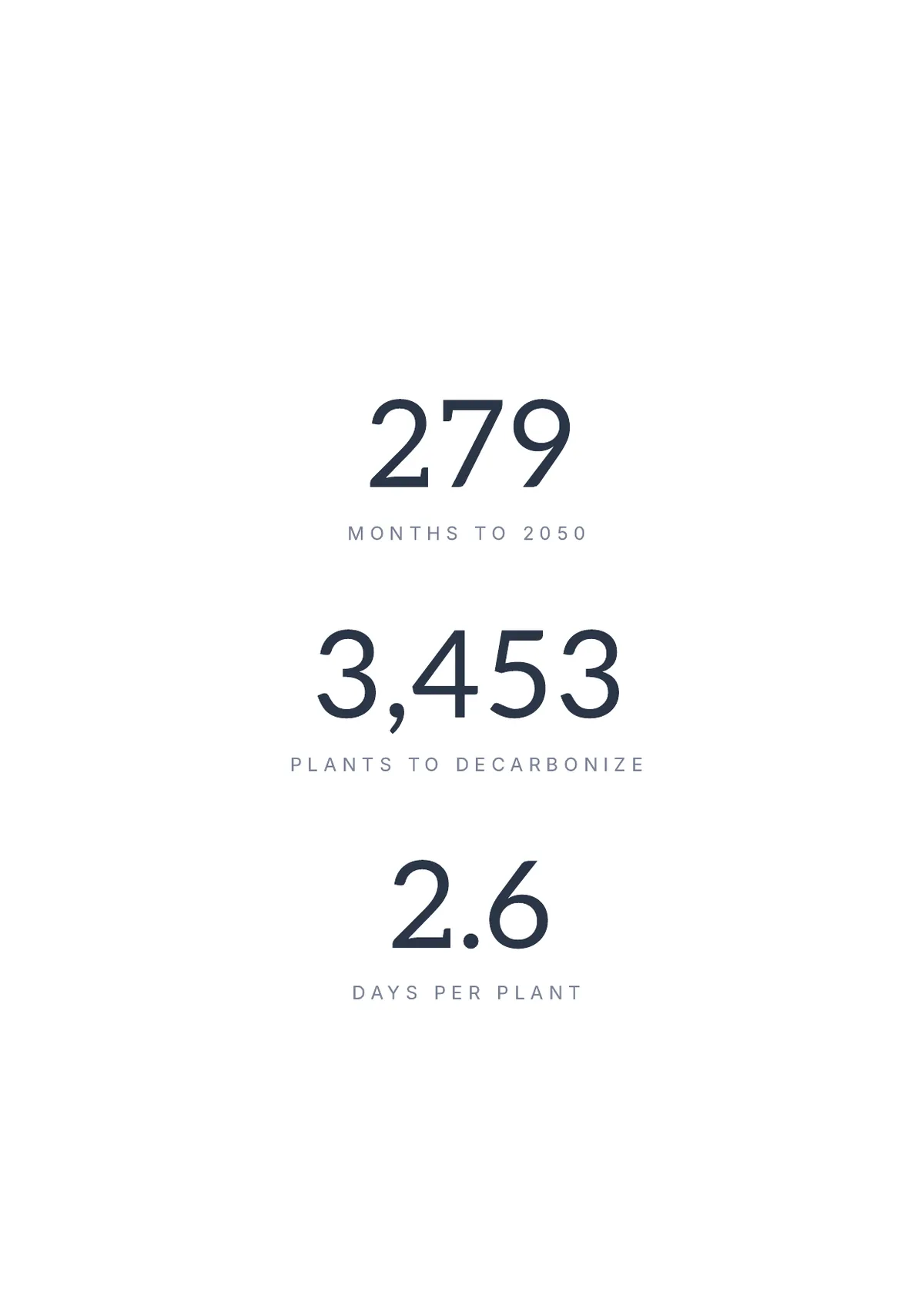
3,453 plants to decarbonize, and 279 months to do it. This is our field guide for the climb: what CTC is carrying, and what we need partners to pack.

Page 1 of 24
Contents
Read the text version
Page 1A Capital Market for Concrete Decarbonization
A field guide to climbing the mountain, 2027.
Concrete Transition Capital · Fall 2026
Page 22027: the year of solutions
Dear Friends:
2025 was rough for green concrete and 2026 brought its own surprise shocks. With a new lay of the land, 2027 is the year we can stop admiring the problem and focus on solutions we can control.
CTC focuses on one critical solution: priming the capital markets for financing the full grey to green transition.
This field guide is by no means an exhaustive list of the ideas and people working hard in this sector. Rather, it highlights the contributions CTC is leading + the complementary efforts others are leading that we feel are most essential for this solution set. It’s our proverbial packing list and the map to success we can climb together, with a little inspiration along the way. So rope up!
Onwards and Upwards,
Miles and Genevieve
Page 3
279 months to 2050.
3,453 plants to decarbonize.
2.6 days per plant.
Page 4The trail map
The challenges that lie ahead.
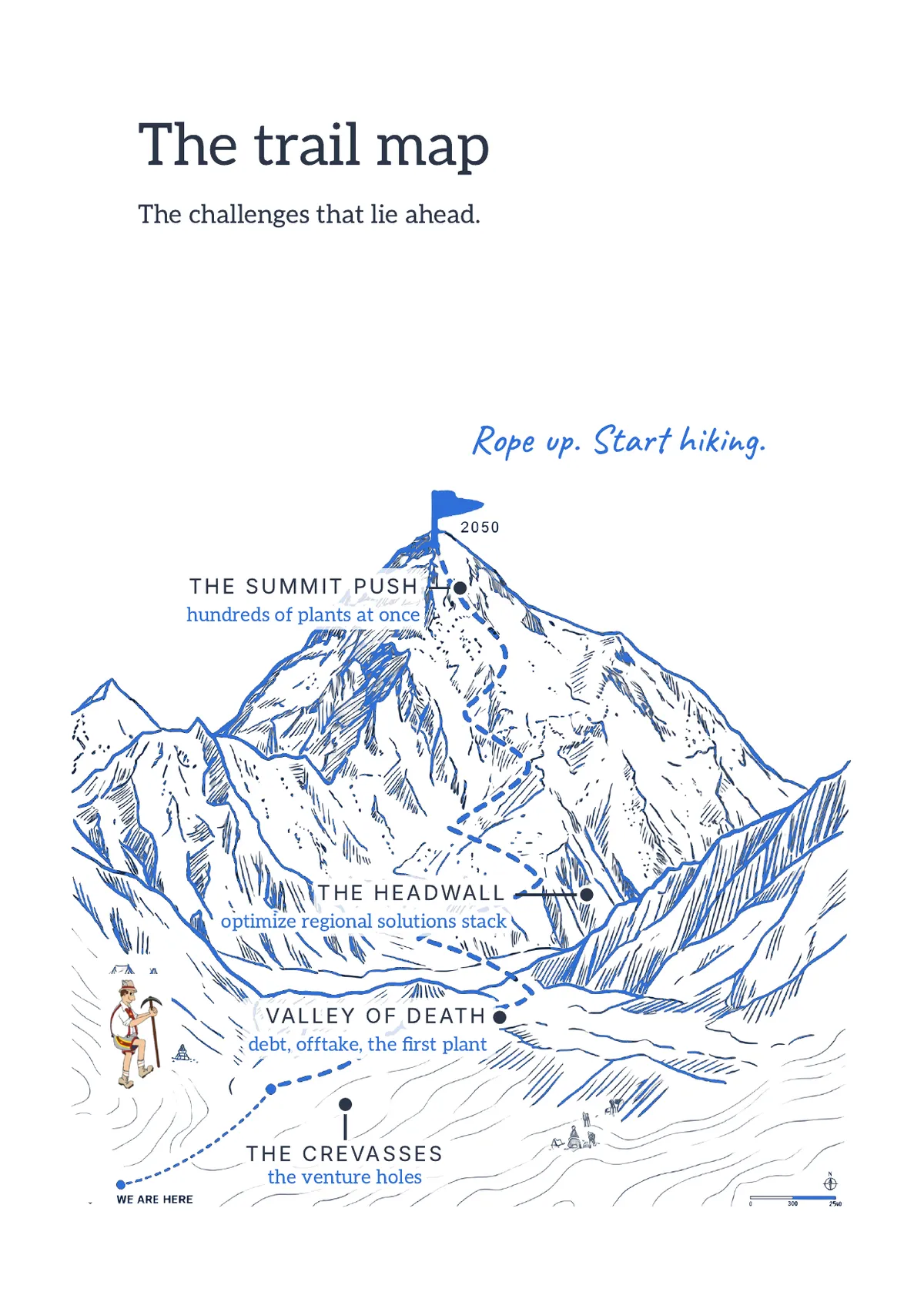
Illustration: a route up a mountain, from “We are here” at the base to a flag marked 2050 at the summit. Rope up. Start hiking.
The crevasses: the venture holes.
Valley of death: debt, offtake, the first plant.
The headwall: optimize regional solutions stack.
The summit push: hundreds of plants at once.
Page 5The packing list
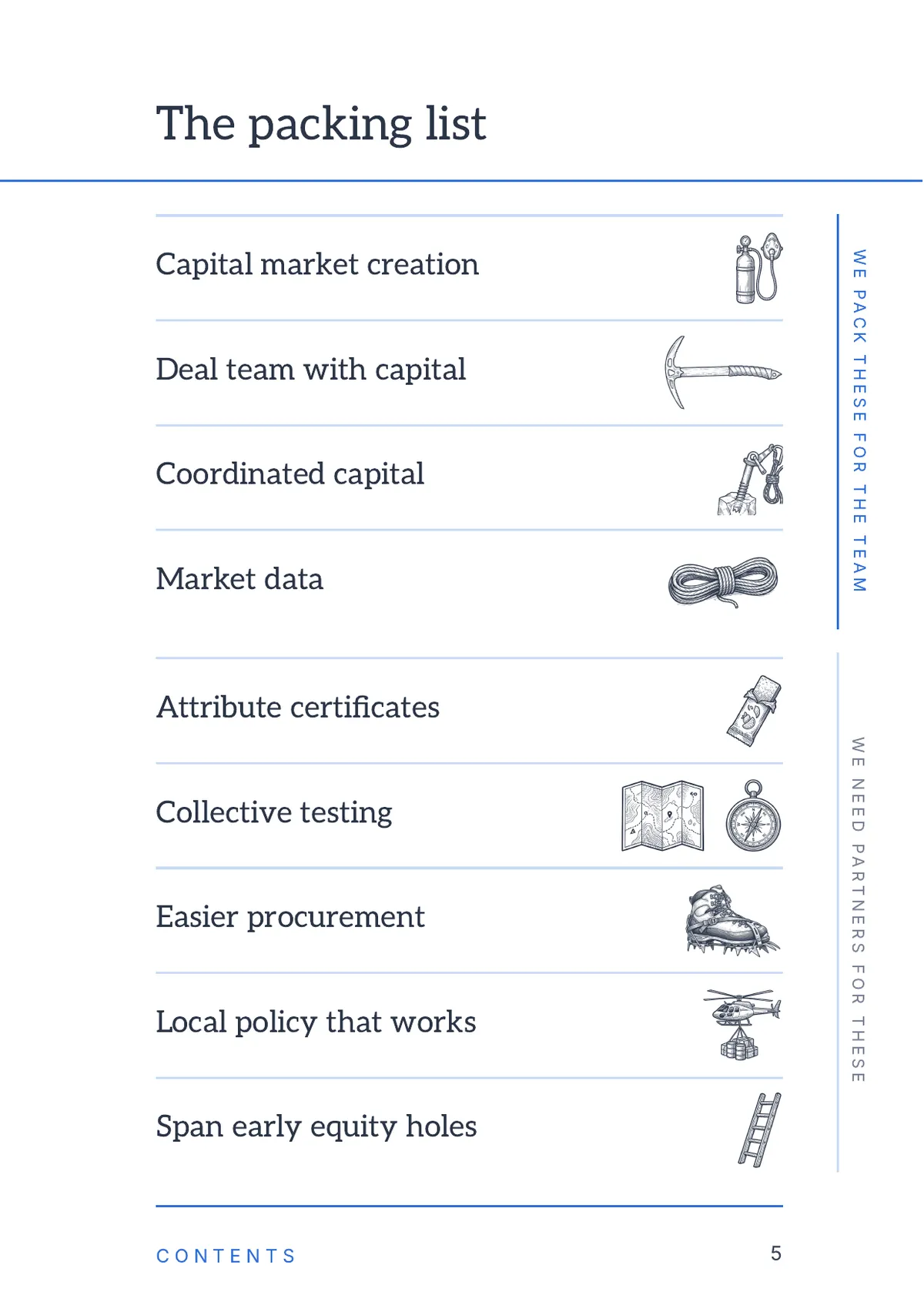
We pack these for the team: capital market creation, deal team with capital, coordinated capital, market data.
We need partners for these: attribute certificates, collective testing, easier procurement, local policy that works, span early equity holes.
Page 6A capital market
$80 billion a year is the summit.
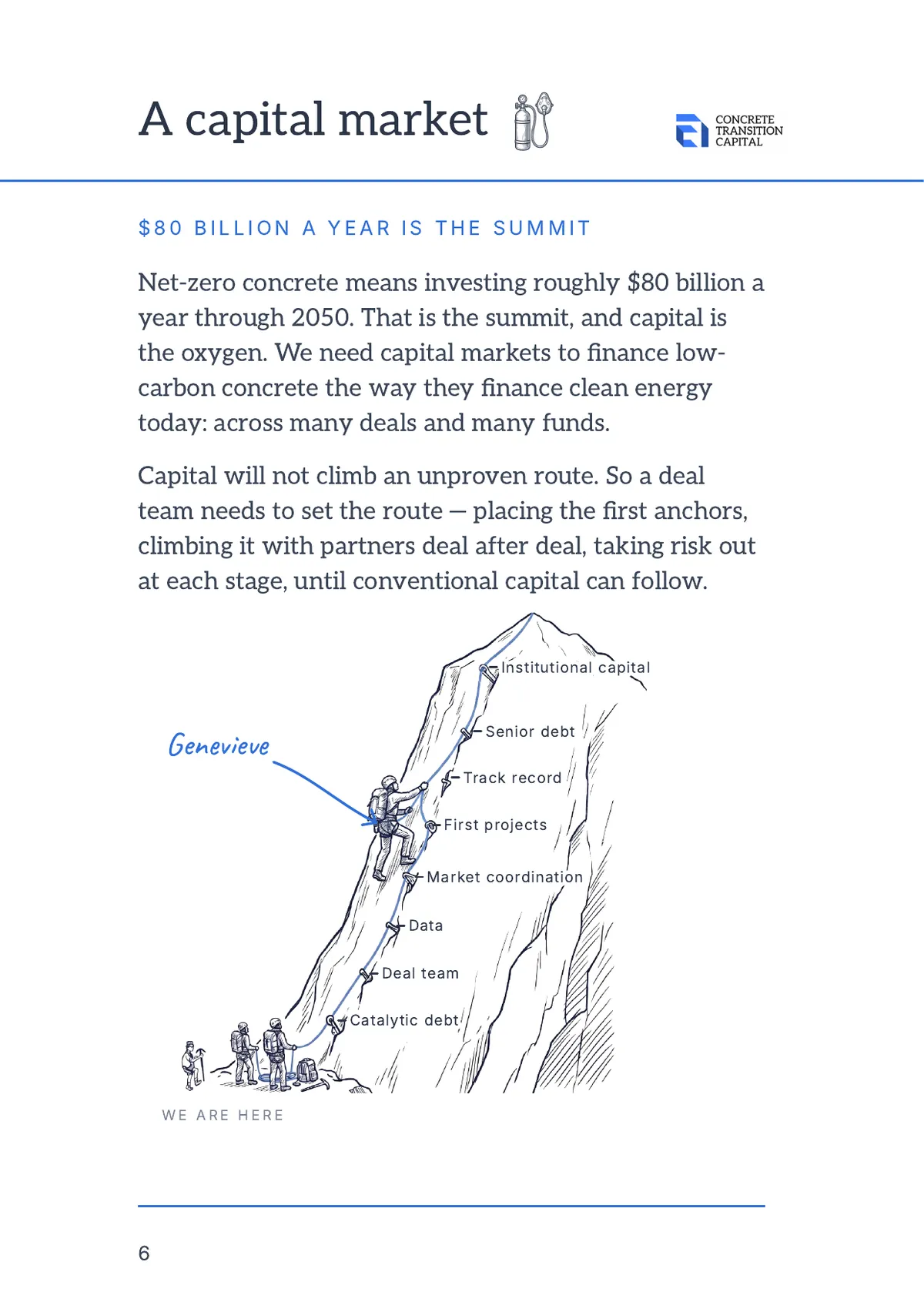
Net-zero concrete means investing roughly $80 billion a year through 2050. That is the summit, and capital is the oxygen. We need capital markets to finance low-carbon concrete the way they finance clean energy today: across many deals and many funds.
Capital will not climb an unproven route. So a deal team needs to set the route — placing the first anchors, climbing it with partners deal after deal, taking risk out at each stage, until conventional capital can follow.
Illustration: Genevieve leads a rope team up a rock face from “We are here”. The route climbs through catalytic debt, deal team, data, market coordination, first projects, track record and senior debt to institutional capital at the top.
Page 7The deal team
CTC’s deal team is the first-ever and only dedicated credit team focused solely on cement & concrete.
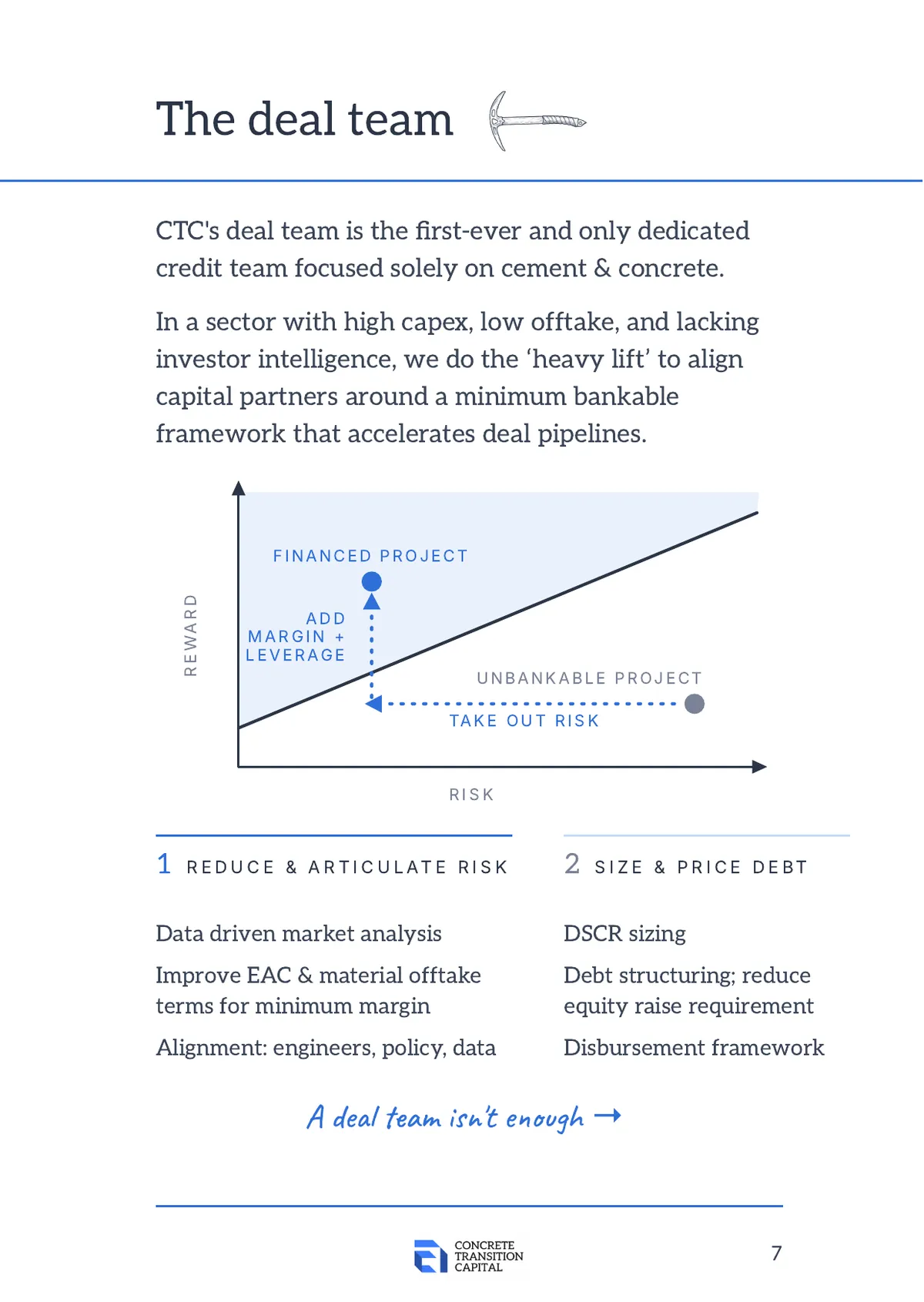
In a sector with high capex, low offtake, and lacking investor intelligence, we do the ‘heavy lift’ to align capital partners around a minimum bankable framework that accelerates deal pipelines.
Chart: risk against reward. Taking out risk, then adding margin and leverage, moves an unbankable project up into a financed project.
1. Reduce & articulate risk: data driven market analysis; improve EAC & material offtake terms for minimum margin; alignment: engineers, policy, data.
2. Size & price debt: DSCR sizing; debt structuring; reduce equity raise requirement; disbursement framework.
A deal team isn’t enough →
Page 8The capital coordination
The CTC Fund
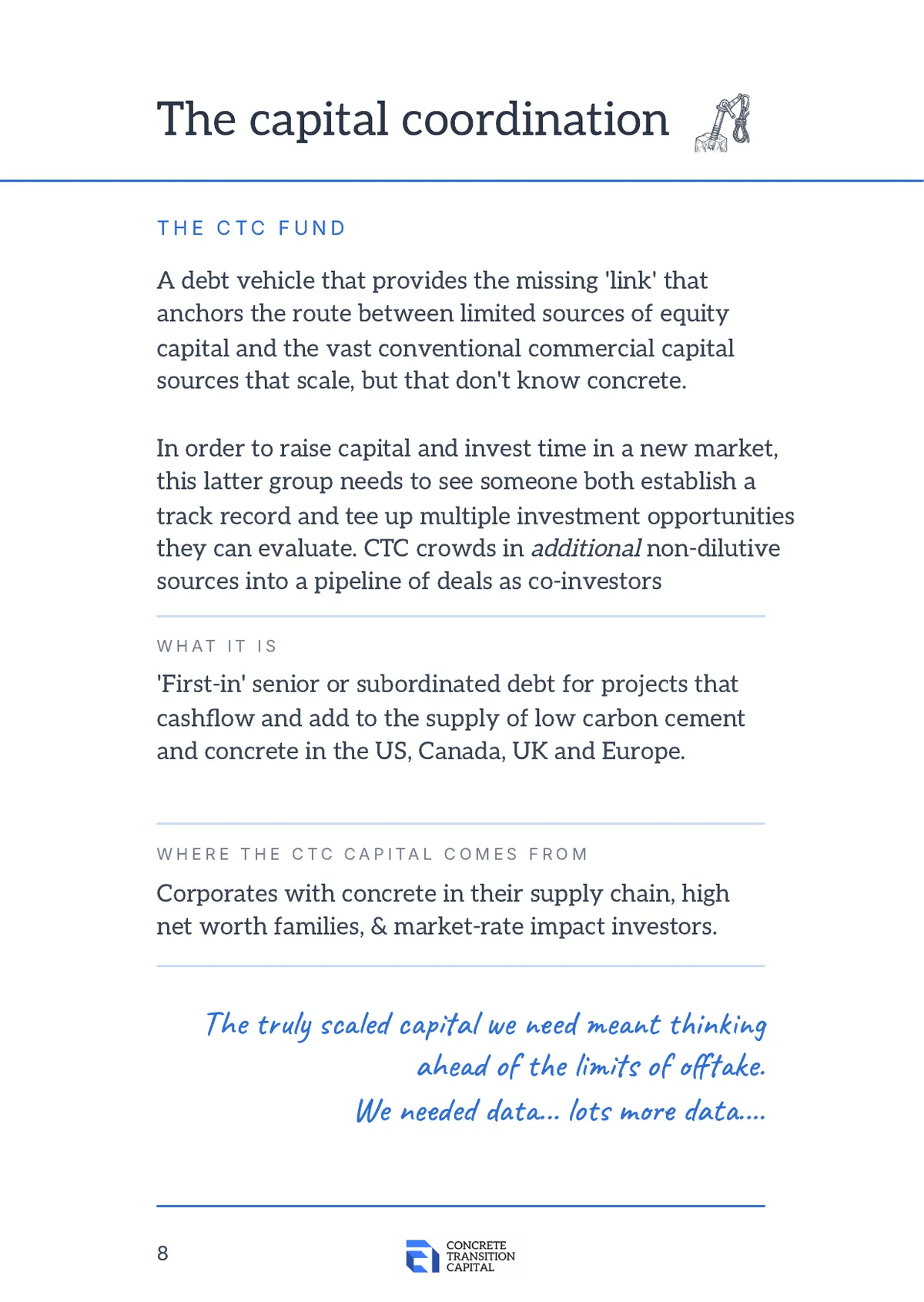
A debt vehicle that provides the missing ‘link’ that anchors the route between limited sources of equity capital and the vast conventional commercial capital sources that scale, but that don’t know concrete.
In order to raise capital and invest time in a new market, this latter group needs to see someone both establish a track record and tee up multiple investment opportunities they can evaluate. CTC crowds in additional non-dilutive sources into a pipeline of deals as co-investors
What it is: ‘First-in’ senior or subordinated debt for projects that cashflow and add to the supply of low carbon cement and concrete in the US, Canada, UK and Europe.
Where the CTC capital comes from: Corporates with concrete in their supply chain, high net worth families, & market-rate impact investors.
The truly scaled capital we need meant thinking ahead of the limits of offtake. We needed data… lots more data….
Page 9The data to derisk projects
The Concrete Terminal
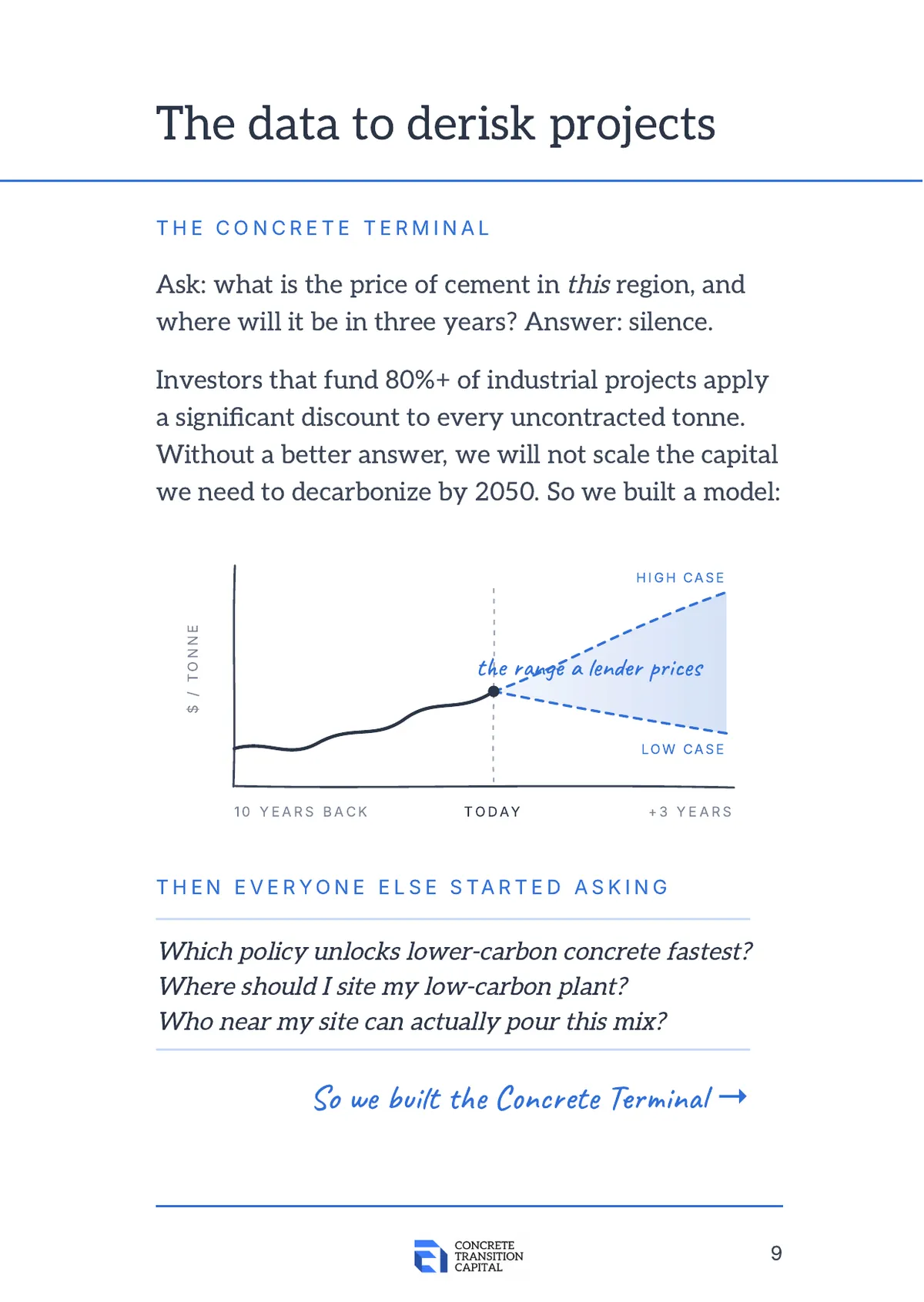
Ask: what is the price of cement in this region, and where will it be in three years? Answer: silence.
Investors that fund 80%+ of industrial projects apply a significant discount to every uncontracted tonne. Without a better answer, we will not scale the capital we need to decarbonize by 2050. So we built a model:
Chart: the price of cement in dollars per tonne, from ten years back to today, then fanning out to a high case and a low case three years ahead. The space between them is the range a lender prices.
Then everyone else started asking:
Which policy unlocks lower-carbon concrete fastest?
Where should I site my low-carbon plant?
Who near my site can actually pour this mix?
So we built the Concrete Terminal →
Page 10The Concrete Terminal
Break market inertia and get climbing.
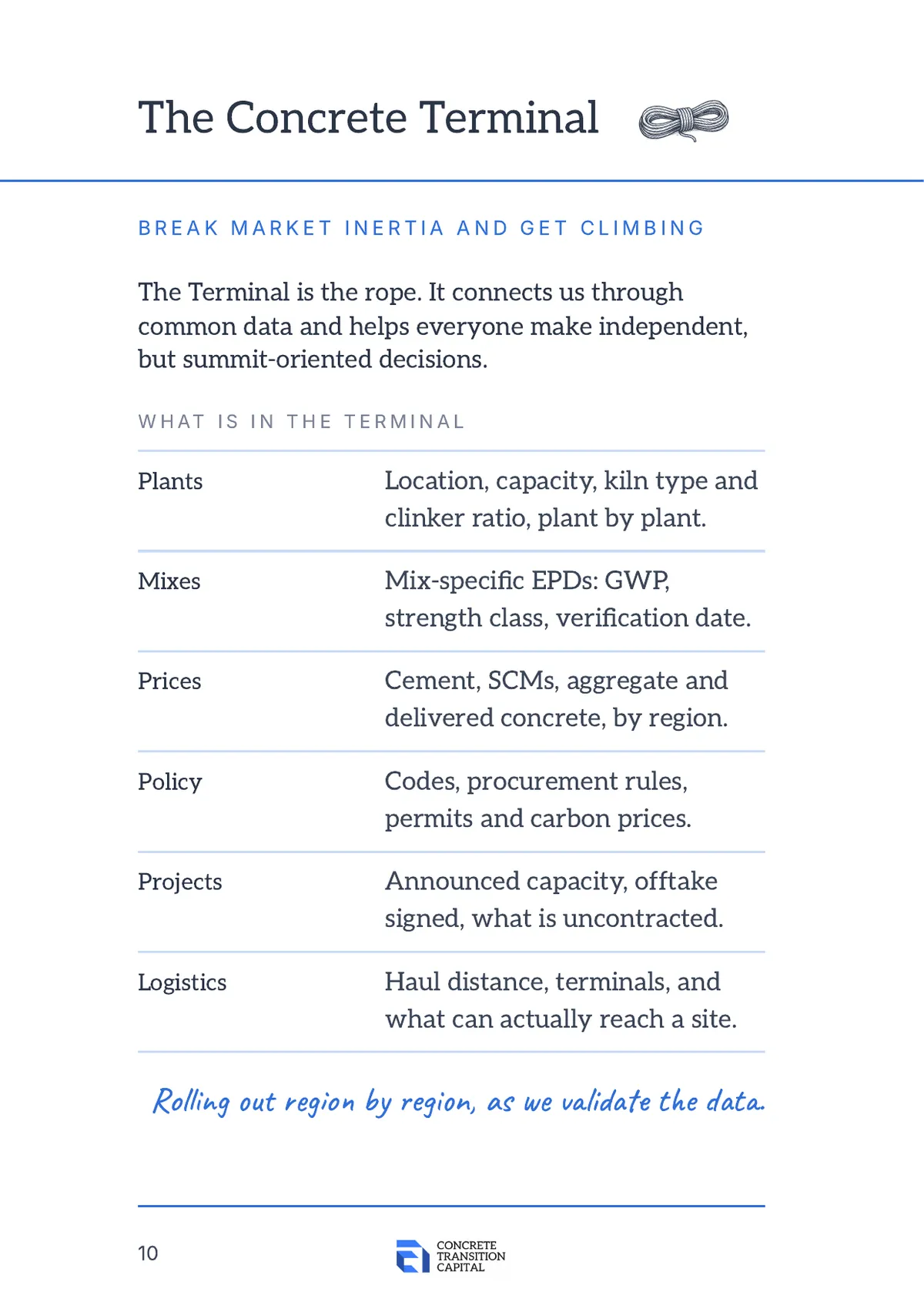
The Terminal is the rope. It connects us through common data and helps everyone make independent, but summit-oriented decisions.
What is in the Terminal:
Plants: location, capacity, kiln type and clinker ratio, plant by plant.
Mixes: mix-specific EPDs: GWP, strength class, verification date.
Prices: cement, SCMs, aggregate and delivered concrete, by region.
Policy: codes, procurement rules, permits and carbon prices.
Projects: announced capacity, offtake signed, what is uncontracted.
Logistics: haul distance, terminals, and what can actually reach a site.
Rolling out region by region, as we validate the data.
Page 11Need help? Ask the Terminal
Like a rope, it is always there for you.
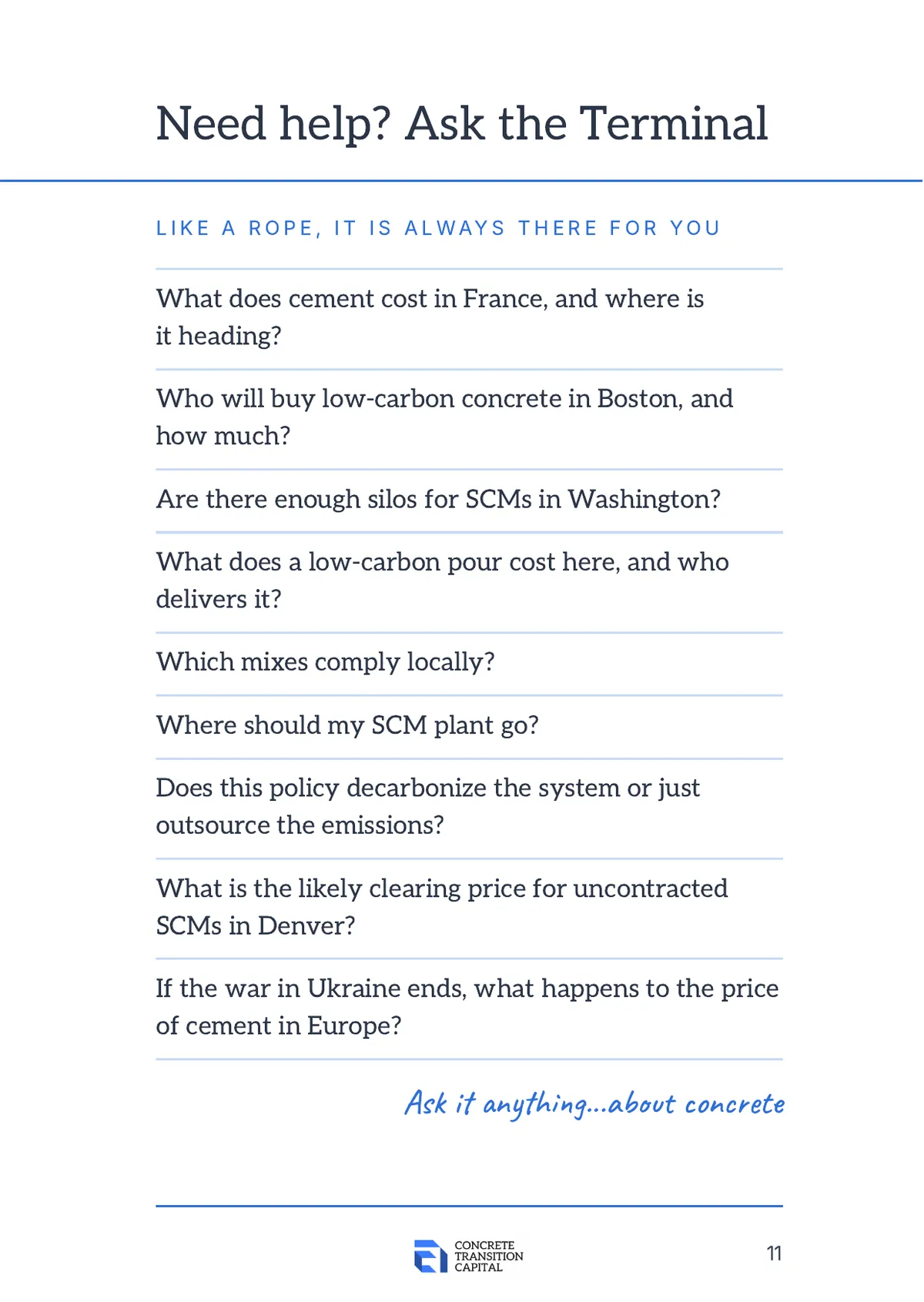
What does cement cost in France, and where is it heading?
Who will buy low-carbon concrete in Boston, and how much?
Are there enough silos for SCMs in Washington?
What does a low-carbon pour cost here, and who delivers it?
Which mixes comply locally?
Where should my SCM plant go?
Does this policy decarbonize the system or just outsource the emissions?
What is the likely clearing price for uncontracted SCMs in Denver?
If the war in Ukraine ends, what happens to the price of cement in Europe?
Ask it anything… about concrete
Page 12Attribute certificates
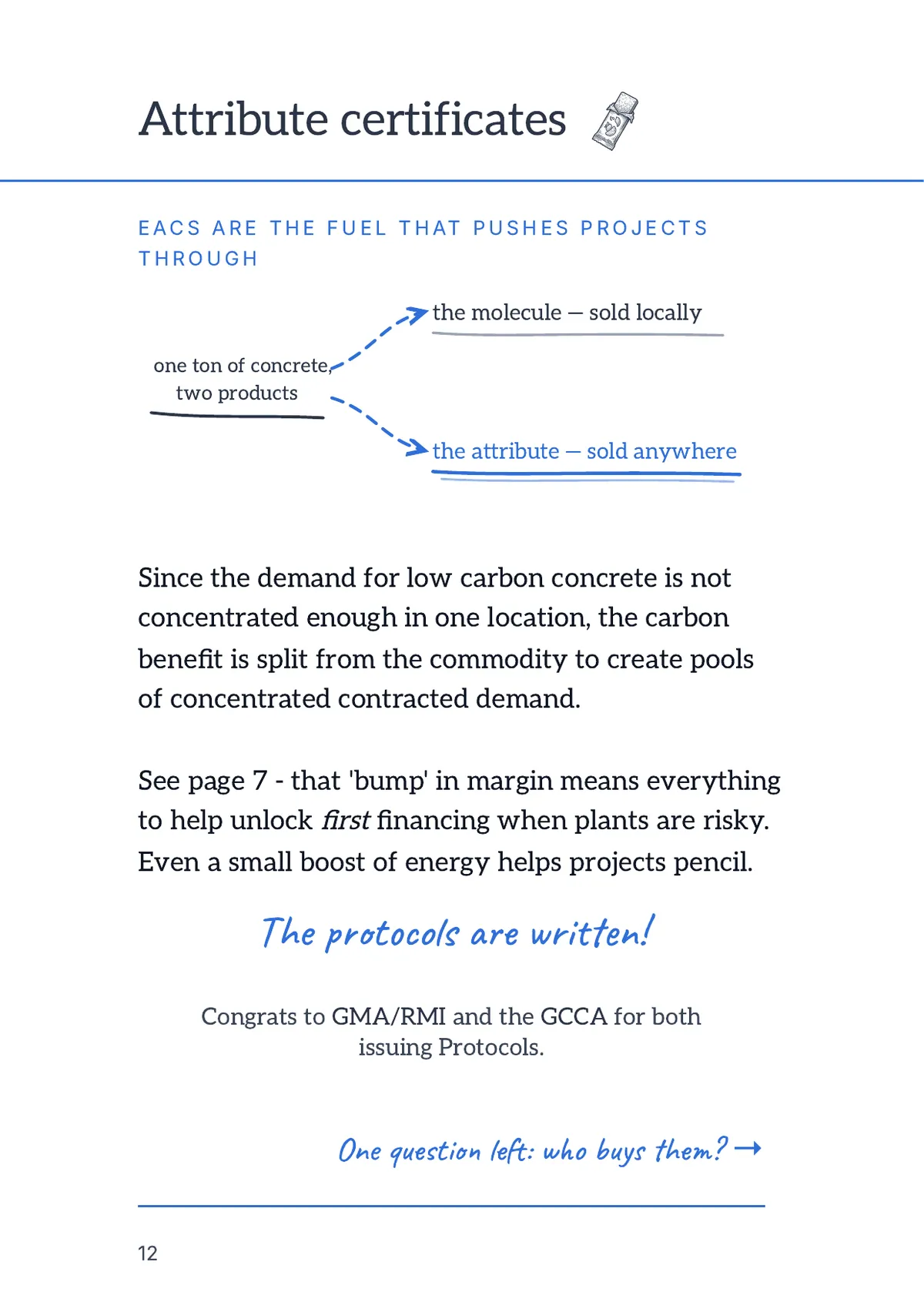
EACs are the fuel that pushes projects through.
One ton of concrete, two products: the molecule, sold locally, and the attribute, sold anywhere.
Since the demand for low carbon concrete is not concentrated enough in one location, the carbon benefit is split from the commodity to create pools of concentrated contracted demand.
See page 7 - that ‘bump’ in margin means everything to help unlock first financing when plants are risky. Even a small boost of energy helps projects pencil.
The protocols are written! Congrats to GMA/RMI and the GCCA for both issuing Protocols.
One question left: who buys them? →
Page 13Here is who needs to buy them
The hyperscalers started this market and proved the attribute works. The buyers who can scale it are the builders, occupants and financiers of buildings and infrastructure: developers and governments. How they can influence EAC purchasing:
01 Government requires it. Government decides what gets built where. Require EACs in all EPDs for public permits and establish compliance markets.
02 Tenants ask for it. Tenants already pay for low EUI or LEED-certified space. Align EAC insets in embodied carbon standards and link demand to leasing.
03 Capital demands it. Corporate developers or their LPs can require EACs for Scope III and whole construction portfolios move at once.
Ask the Terminal: What scale and price of EACs does the system need?
Page 14Collective Testing
Test once. Share. Everybody uses it.
The stakes: Today, every producer re-tests the same mixes for every engineer. Do we really need to redraw the map every time?
Who is on it: Universities · National Labs · Private Consortia (ACDG; Data Center Accelerator) · Civil Society Orgs
A better way - who jumped ahead: In London, one developer — Derwent London — convened the ACDG: 36 firms, developer-led and industry-wide, testing as one cohort instead of thirty-six. They will secure the decarbonized supply chain and scale faster.
Why it worked: The whole delivery chain sat at one table — nine competing developers, the contractors, and the engineers who must sign the specs. Demand led; supply answered.
Ask the Terminal: Has this mix been tested already and where is the data?
Page 15The playbook
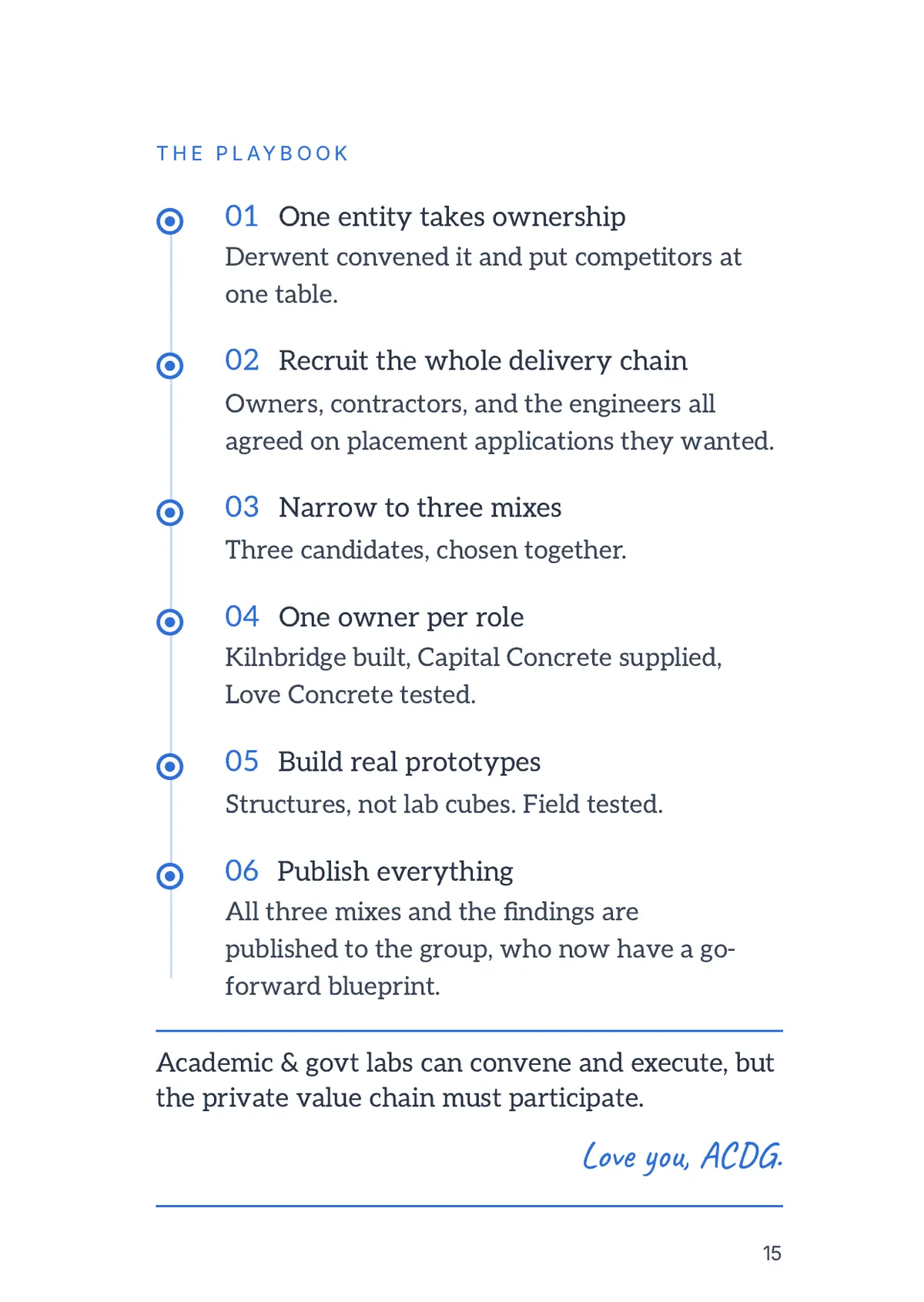
01 One entity takes ownership. Derwent convened it and put competitors at one table.
02 Recruit the whole delivery chain. Owners, contractors, and the engineers all agreed on placement applications they wanted.
03 Narrow to three mixes. Three candidates, chosen together.
04 One owner per role. Kilnbridge built, Capital Concrete supplied, Love Concrete tested.
05 Build real prototypes. Structures, not lab cubes. Field tested.
06 Publish everything. All three mixes and the findings are published to the group, who now have a go-forward blueprint.
Academic & govt labs can convene and execute, but the private value chain must participate.
Love you, ACDG.
Page 16Easier procurement
Make it the easy order to place.
A lot of work has been done on making procurement easier. These are the boots with crampons. We need to keep walking and using them every day.
What already exists:
GCCA Low Carbon Ratings — one grade, AA to G, read off numbers an EPD already carries.
Building Transparency — a public database of mix-specific EPDs, searchable by plant.
Lower Carbon Concrete Group — a published guide to performance-based & placement application, by stage.
Performance over prescriptive specs — the recommendations are written and free to read.
Ask the Terminal: What does each member of the project team need to place the order? Can I see clearly that I can get what I need?
Page 17Quick checklist
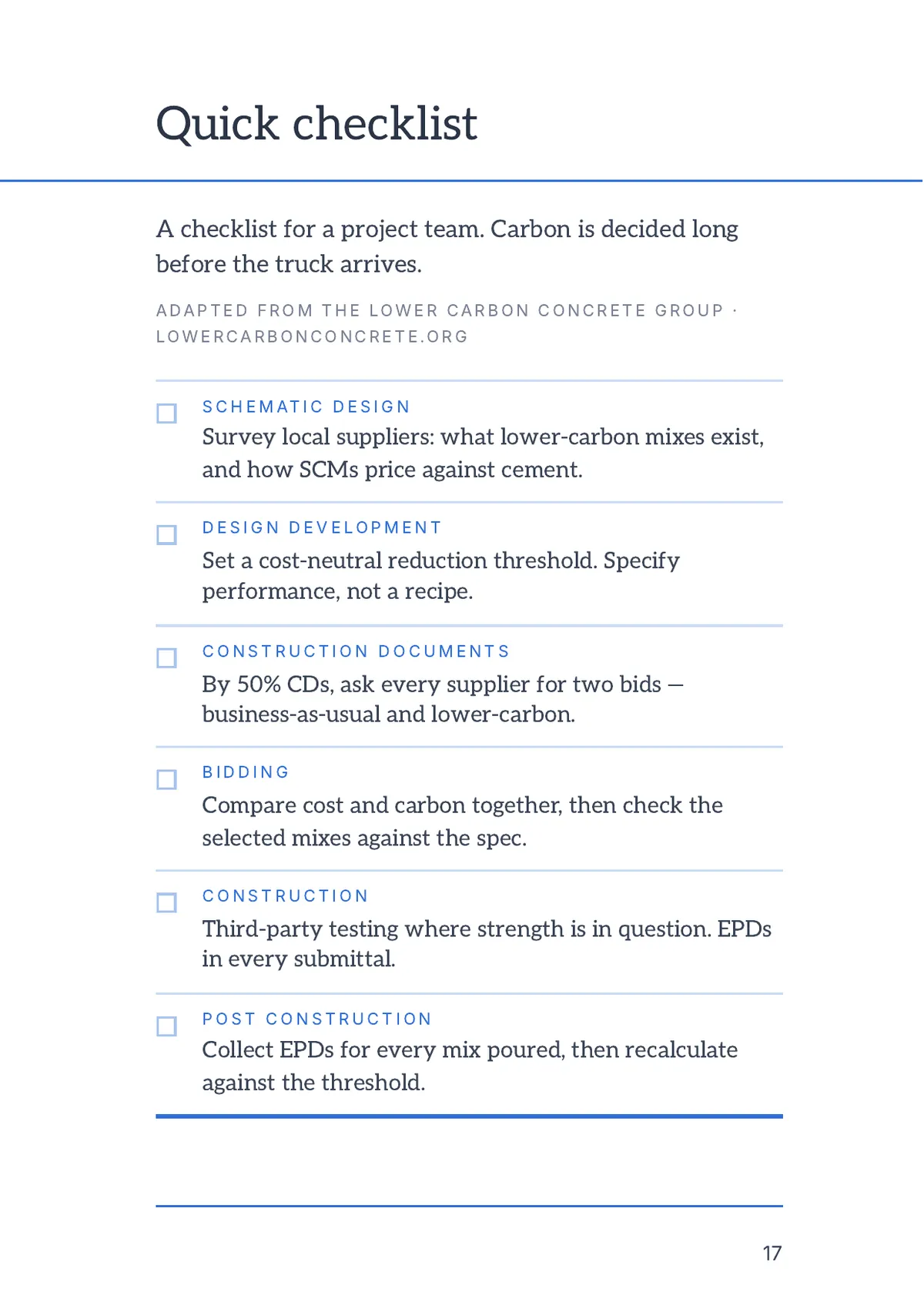
A checklist for a project team. Carbon is decided long before the truck arrives.
Adapted from the Lower Carbon Concrete Group · lowercarbonconcrete.org
Schematic design: Survey local suppliers: what lower-carbon mixes exist, and how SCMs price against cement.
Design development: Set a cost-neutral reduction threshold. Specify performance, not a recipe.
Construction documents: By 50% CDs, ask every supplier for two bids — business-as-usual and lower-carbon.
Bidding: Compare cost and carbon together, then check the selected mixes against the spec.
Construction: Third-party testing where strength is in question. EPDs in every submittal.
Post construction: Collect EPDs for every mix poured, then recalculate against the threshold.
Page 18Local policy that works
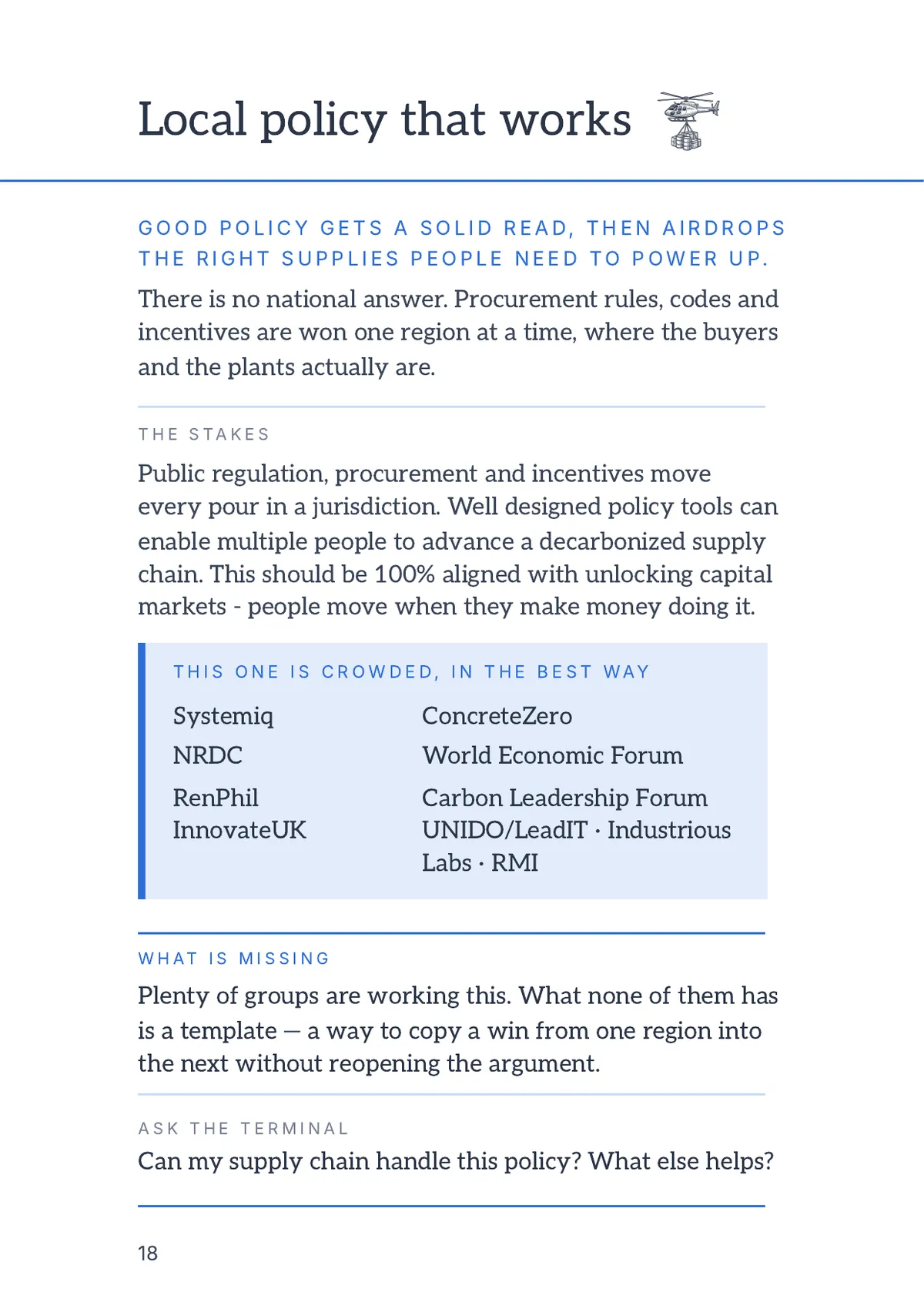
Good policy gets a solid read, then airdrops the right supplies people need to power up.
There is no national answer. Procurement rules, codes and incentives are won one region at a time, where the buyers and the plants actually are.
The stakes: Public regulation, procurement and incentives move every pour in a jurisdiction. Well designed policy tools can enable multiple people to advance a decarbonized supply chain. This should be 100% aligned with unlocking capital markets - people move when they make money doing it.
This one is crowded, in the best way: Systemiq · NRDC · RenPhil · InnovateUK · ConcreteZero · World Economic Forum · Carbon Leadership Forum · UNIDO/LeadIT · Industrious Labs · RMI
What is missing: Plenty of groups are working this. What none of them has is a template — a way to copy a win from one region into the next without reopening the argument.
Ask the Terminal: Can my supply chain handle this policy? What else helps?
Page 19
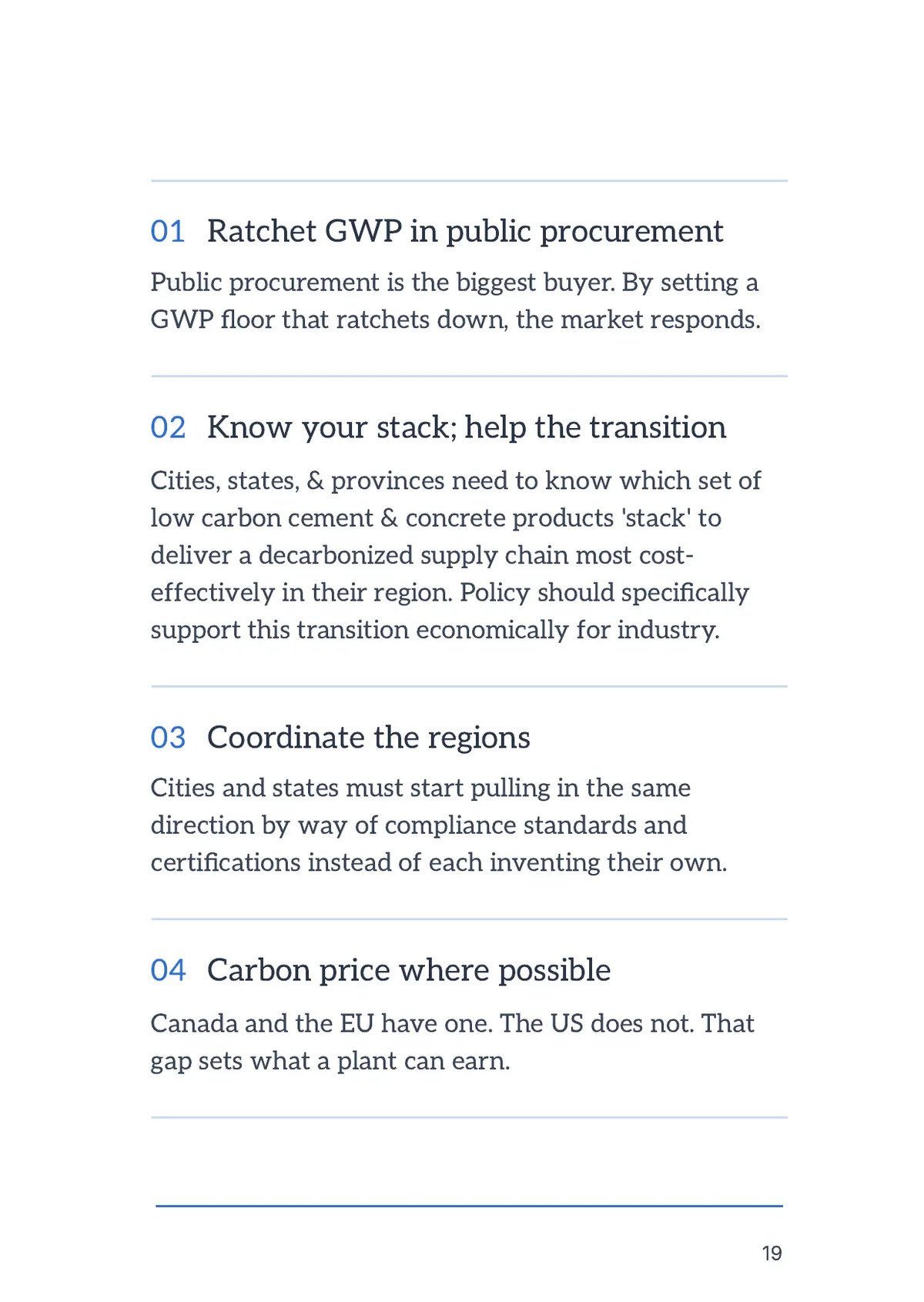
01 Ratchet GWP in public procurement. Public procurement is the biggest buyer. By setting a GWP floor that ratchets down, the market responds.
02 Know your stack; help the transition. Cities, states, & provinces need to know which set of low carbon cement & concrete products ‘stack’ to deliver a decarbonized supply chain most cost-effectively in their region. Policy should specifically support this transition economically for industry.
03 Coordinate the regions. Cities and states must start pulling in the same direction by way of compliance standards and certifications instead of each inventing their own.
04 Carbon price where possible. Canada and the EU have one. The US does not. That gap sets what a plant can earn.
Page 20Span Early Equity Holes
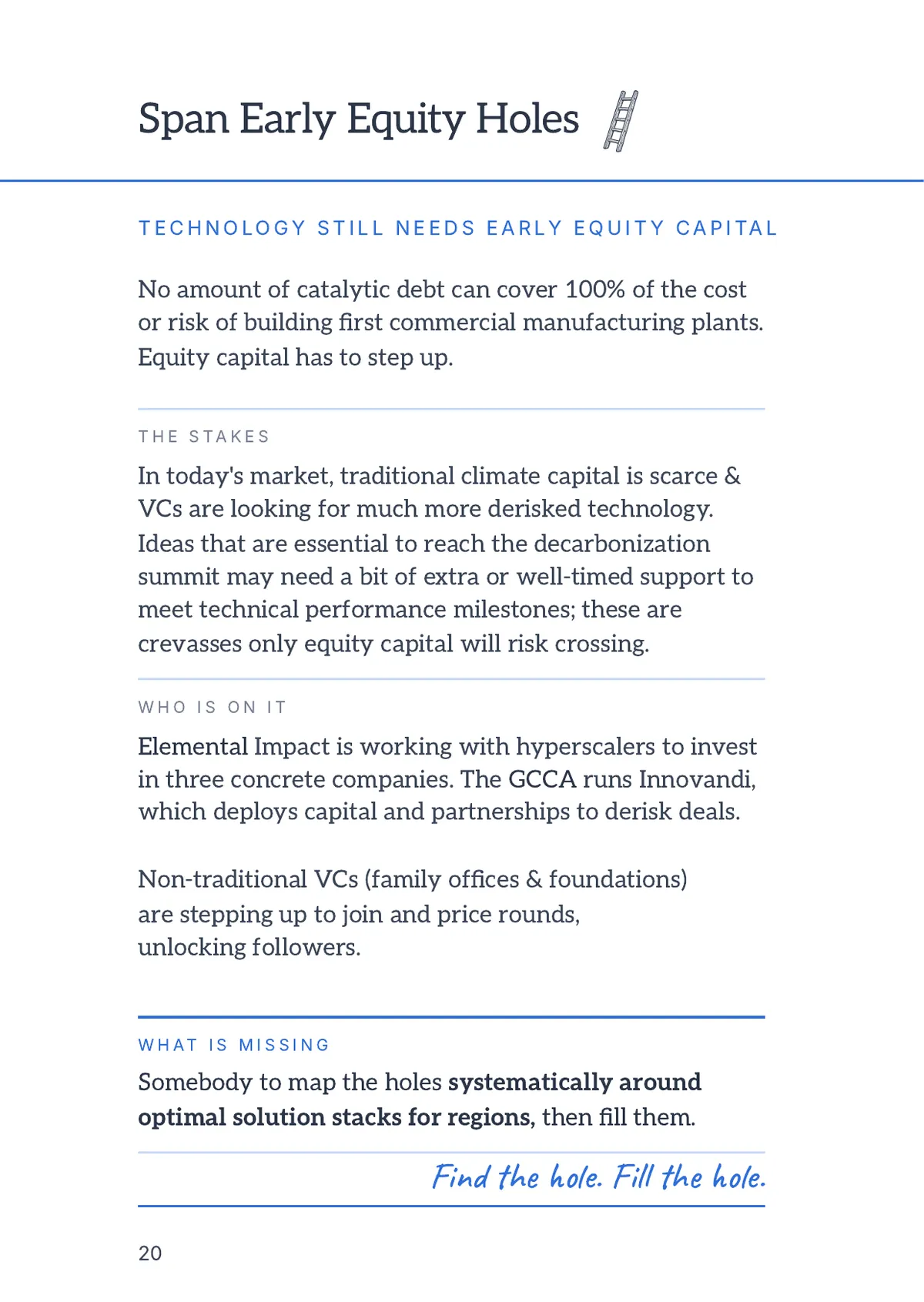
Technology still needs early equity capital.
No amount of catalytic debt can cover 100% of the cost or risk of building first commercial manufacturing plants. Equity capital has to step up.
The stakes: In today’s market, traditional climate capital is scarce & VCs are looking for much more derisked technology. Ideas that are essential to reach the decarbonization summit may need a bit of extra or well-timed support to meet technical performance milestones; these are crevasses only equity capital will risk crossing.
Who is on it: Elemental Impact is working with hyperscalers to invest in three concrete companies. The GCCA runs Innovandi, which deploys capital and partnerships to derisk deals.
Non-traditional VCs (family offices & foundations) are stepping up to join and price rounds, unlocking followers.
What is missing: Somebody to map the holes systematically around optimal solution stacks for regions, then fill them.
Find the hole. Fill the hole.
Page 21In / Out
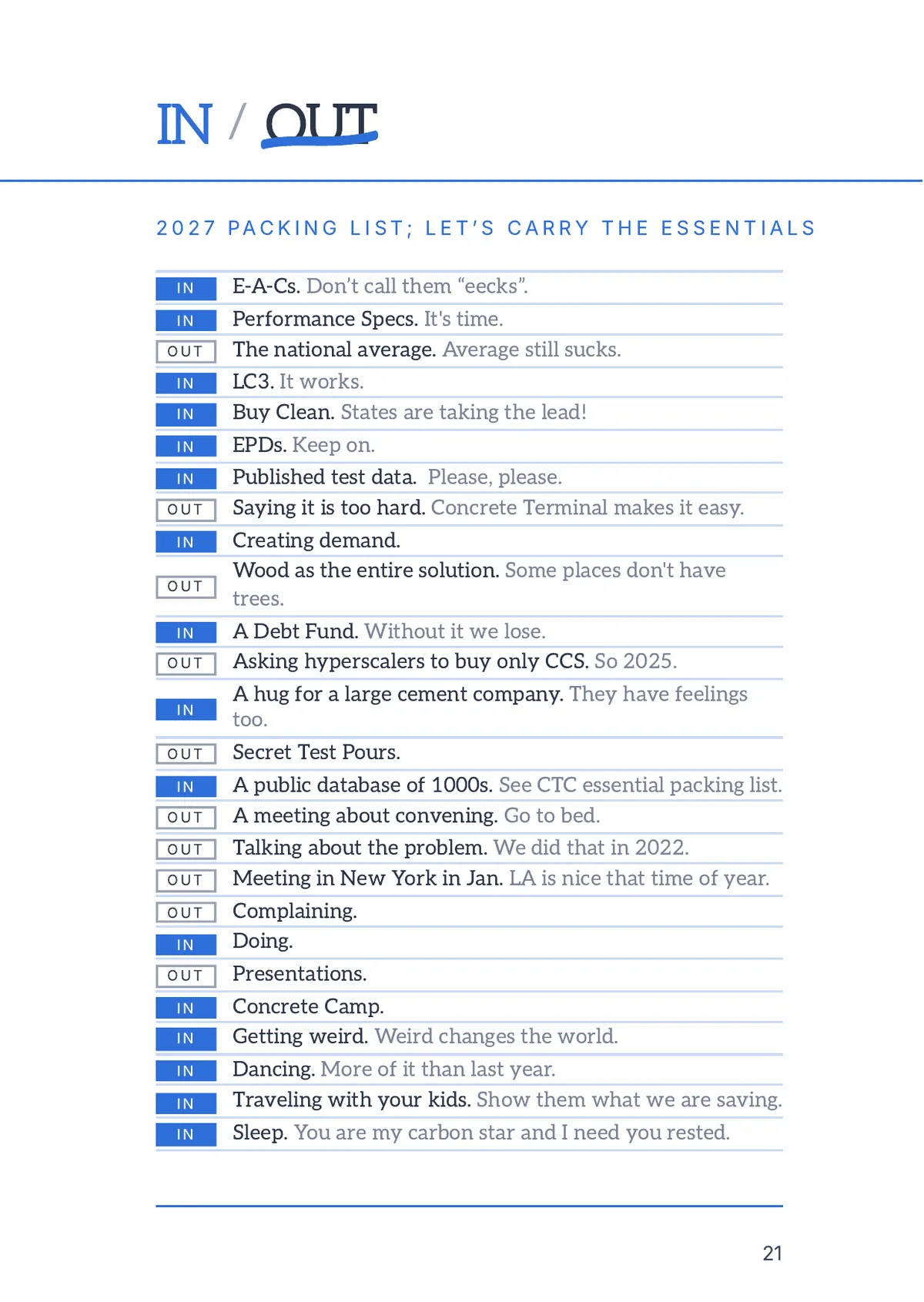
2027 packing list; let’s carry the essentials.
In: E-A-Cs. Don’t call them “eecks”.
In: Performance Specs. It’s time.
Out: The national average. Average still sucks.
In: LC3. It works.
In: Buy Clean. States are taking the lead!
In: EPDs. Keep on.
In: Published test data. Please, please.
Out: Saying it is too hard. Concrete Terminal makes it easy.
In: Creating demand.
Out: Wood as the entire solution. Some places don’t have trees.
In: A Debt Fund. Without it we lose.
Out: Asking hyperscalers to buy only CCS. So 2025.
In: A hug for a large cement company. They have feelings too.
Out: Secret Test Pours.
In: A public database of 1000s. See CTC essential packing list.
Out: A meeting about convening. Go to bed.
Out: Talking about the problem. We did that in 2022.
Out: Meeting in New York in Jan. LA is nice that time of year.
Out: Complaining.
In: Doing.
Out: Presentations.
In: Concrete Camp.
In: Getting weird. Weird changes the world.
In: Dancing. More of it than last year.
In: Traveling with your kids. Show them what we are saving.
In: Sleep. You are my carbon star and I need you rested.
Page 22None of us can do this alone
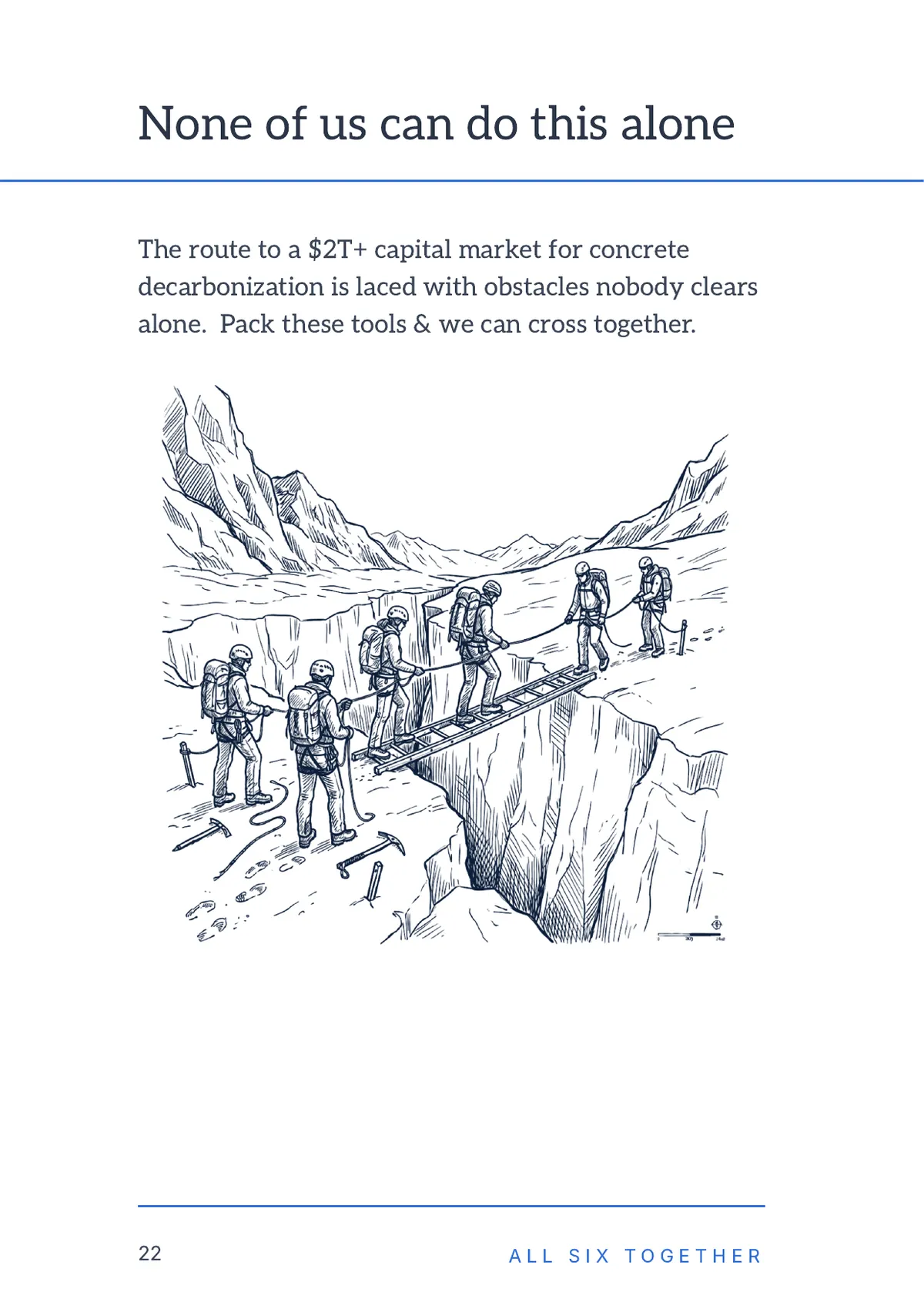
The route to a $2T+ capital market for concrete decarbonization is laced with obstacles nobody clears alone. Pack these tools & we can cross together.
Illustration: six climbers, roped together, cross a crevasse on a ladder.
All six together
Page 23We were made for this.
Around it, the names of the people on the climb: Miles Haladay · Genevieve Sherman · François-Jérôme Selosse · Wesley Garner · Jennifer Louie · David Hirsch · Scott Wozencraft · Maddi Reeves · Alison Kinn Bennett · Sara Neff · Kyle McEneaney · Jason Mühleck · Joe Hicken · Erin Glabets · Heather House · Andrew Yi · Mikhail Haramati · Andrew Alcorta · Juan Moreno · Rebecca Hutman · Alex Harbour · Ric Cochrane · Bob Bennett · Marta Sjögren · Matthew Cullinen · Scott Shell · Markus Gatterwe · Christoph Zinsser · Vighnesh Daas · Ian Goulding · Steven Burke · Imani Hamilton · Jessica Lam · Julia Gisewite · Isaac Sonnenfeldt · Nia Bell · John Anagnostou · Bengt Steinbrecher · Julius Kusuma · Vaclav Hasik · Samantha Carlsson · Ben Stapleton · Hayley Moller · Jonson Berman · David Lynn · Aaron Schifrin · Jack Cove · Patrick McGrath · Elli-Nikoletta Argyrou · Ellen Aarinen · Tom Angus · Hind Katkhuda · Michael Niska · Rae Oakley · Patrycja Drainville · Kathryne Benesh · Jonathan Flaherty · Vincent Martinez · Kyle Pickett · Madison Savilow · Lisa Khanna · Chris Mangieri · Noah Goldstein · Marshall Andrews · Mandeep Arora · Willy Carlsen · Ayo Olabimtan · Apoorv Sinha · Erik Uruosa · John Anderson · Carey Haladay · Maria Pantelaros · Winston Beck · Christopher Sidwa · Kavita Patel · Tim Kuebler · Eoin Condren · James Lindsay · Kimberly Dowdell · Kamaria Campbell · Jeff Ochs · Joanna Hamid · Kevin Davis · Peter Weisberg · Frances Yang · Peter Hirsch · Benjamin Lesser · B. Skinner · Lucy Kessler · Sarah Power · Anthony Hickling · Shahrukh Shamim · Anjy Salinas · Ana Aday · Laura Cannici · Timothy Henderson · Rupa Ved · Dalraj Nijjar · Jark Gendner · Peter Metz · Marc Diaz · Christy Stanker · Cindy Jia · James Drinkwater · Tulika Raj · Lee Scott · Michael Jones · Gentian Limani · Orla Docherty · John Chaparro · Monica Chhatwani · Madeline Rose · Chris Rhie · Wan Li Zhu · Kim Krempien · Martyn Kenny · Christian Hernandez Gallardo · Grace Meisel · Martin Kloeck · Anette Murphy · Chandler Randol · Kelly Matti · Maia Sperber · Daniel Huber · Ryan Gilliam · Tim Bush · Matthew Hessey · Bryan Shill · Kathleen Dunleavy · Christina Theodoridi · Yici Wang · Clayton Gerber · Daniel Vargas · Don Davies · Stephen Scofield · Wes Fellow · Will Hudson · Rajal Bodhania · Christina Pastoria · Anuradha Balaji · Katie Ross · Joan Gibbons · Peter Kelly · Rama Dunayevich · Alex Kleiman · Cory Waltrip · Ramy Fam · Kristofer Wilson · Liliana Maria Cruz · Marion Guenebeaud · Jack Fritzinger · Roald Brouwer · Albert Luu · Hyder Shuja · Adrian Rodrigues · Jennifer Cass · Eliot Brooks · Jordana Pleat · Benjamin Constant · Paul Bodnar · Dave Gersholowitz · Dhriti Bhatta · Nick Ellis · Andres Clarens · Koosje Vingerling · Pete Lyons · Harald Burchardt · Jen Carson · Ryan Buckley · Mitch Rubin · Scott Jenkins · Matt Panopio · James Murray-Coleman · Neelam Singh · Lara Pierpoint · Andreas Saari · Tim Lewis · Amy Wang · Austin Badger · Elwin van Rooijen · Andreas Marcotty · Antonio Carrillo · Thomas Miles · Will Nguyen · Oscar Piepers · Meghan Lewis · Ashton Green · Joyanne Manning · Sebastian Andrews · Guylaine Deniel · Christian Okoye · Madeline Hinkamp · Michael Rochmes · Beverly Craig · Alexandra Brandt Corstius · Markus Kritzler · Lauren Holland · Diarmuid Cahill · Alison Greene · Ben Myers · Sam Phelps · Melissa Uhl · Kelsey Rose · Meghan Byrne · Jesus Ortiz De La Fuente · Amy Paterson · Cindy McLaughlin · Ben Stanley · Peter Templeton · Phil De Luna · Bryce Tanner · Camila Zárate
Page 24A small and mighty team, obsessed with decarbonizing concrete in our lifetime.
Concrete Transition Capital
We are a deal team built for cement and concrete — debt structuring alongside people who know the plants, the mixes and the market. We move projects from too risky to fundable.
Alongside the deals we build market alignment and the Concrete Terminal, the data layer this industry has been underwriting without.
concretetransition.com · Fall 2026